September 16, 2026 · Invasive species & bioelectricity · v3
Twelve ways to catch a green crab
A screening exercise across sensory, biological and operational mechanisms for controlling an invasive crab — what each route would need to be true, what closed it, and the two that are still standing.
- [C]
- 45 resolved sources

In short
Twelve candidate mechanisms for preferentially removing an invasive crab, screened one at a time against the physics and the literature. Ten are closed, one is unreachable with available equipment, and two survive — neither of them a device. This is the ledger, including the errors made along the way.
This is a case study of a search that mostly returned no.
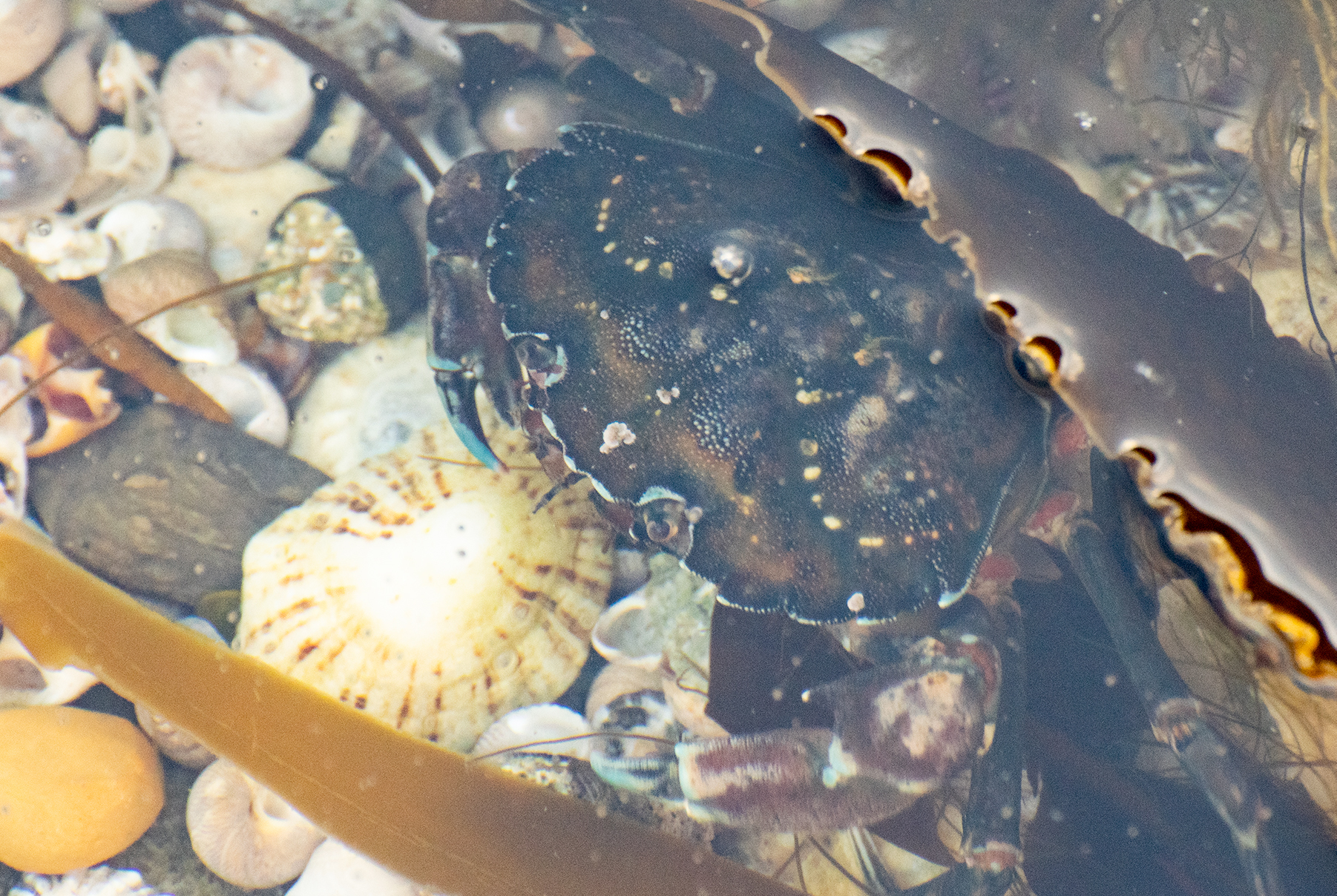
The subject is the European green crab (Carcinus maenas), an invasive portunid established on the coast of British Columbia. The question I set out with was narrow and, I thought, tractable: is there any signal a green crab can detect that a native crab cannot — because if there is, you can build it into a trap and catch one species without catching the other.
Twelve routes were screened. Ten are closed. One is real but unreachable with equipment I can obtain. Two survive, and neither of them is a device.
None of this is novel. Every closure came from applying published work or undergraduate physics to a specific question, and in one case the thing I declared missing from the literature turned out to have been published, with public code, four months earlier. The value here, if there is any, is the shape of the negative results and the order they arrived in — so I am writing it down in public rather than leaving it in a private repository. If any of it saves somebody a month, take it.
The constraint that governs everything
A green crab trap that also catches Dungeness crab is worse than no trap. Dungeness supports British Columbia’s most valuable crab fishery, and juvenile Dungeness share estuarine nursery habitat with juvenile green crab. So “attracts green crab” was never sufficient. The requirement was always differential — something the target detects and the bycatch does not.
That single constraint is what killed most of the twelve.
The ledger
| # | Route | Verdict | What closed it |
|---|---|---|---|
| 1 | Electric prey mimicry — a lure imitating prey bioelectric fields | CLOSED | Prey fields are a contact cue even for a shark; no crustacean electroreceptor has been identified |
| 2 | Magnetic — exploit a reported sex-specific field response | OPEN, unreachable | Real result, unreplicated, no located transducer, and an unresolved thermal confound |
| 3 | Substrate vibration from buried prey | CLOSED | Every catalogued prey sound sits outside the crab’s measured mechanoreceptor band |
| 4 | Water-borne prey sound | CLOSED | Near-field falloff and displacement arithmetic put it at centimetres |
| 5 | Acoustic reproductive interference — mask mating signals | CLOSED | The water is too shallow to propagate the relevant frequencies at all |
| 6 | Chemical prey odour | WORKS, NOT SELECTIVE | Out-ranges every mechanical cue by orders of magnitude, and every crab there smells it |
| 7 | Sex pheromone lure | WORKS, NOT SELECTIVE ENOUGH | Attracts males of the target — and the bycatch problem is unaddressed |
| 8 | Predator cue — flush crabs out of refuge into gear | CLOSED | Requires a cue that moves the target and not the natives; same failure as 6 |
| 9 | Parasite biocontrol | CLOSED, decisively | Host-specificity testing against native Pacific crabs is the standing answer |
| 10 | Native predator recovery | OPEN, not a lever | One landscape-scale success exists; its agent is absent from the relevant water |
| 11 | Gear — trap type and entrance geometry | SURVIVES | Largest demonstrated effect anywhere in this exercise |
| 12 | Place and schedule — where and when the gear is set | SURVIVES | Two independent axes with real supporting evidence |
Five independent lines of work converged on the bottom two rows. That convergence is the single most useful thing the exercise produced, and it took about eight closures to get there.
Where it started: the electromagnetic branch
The project began with a specific published result: juvenile green crabs exposed to static magnetic fields at strengths relevant to submarine power cables showed a sex-specific response, with females spending more time in exposed zones and males showing no consistent preference.
That is exactly the shape of thing the constraint above demands — a differential response, in the target species, in a channel you can generate with a coil. It is why this project exists at all.
Three things had to be true for it to become a trap, and I could establish none of them.
First, a mechanism. No transducer has been located. The obvious comparison is the spiny lobster, the standard invertebrate magnetoreception system — but the receptor cells have not been located and characterised in that animal either. Mapping a mechanism from one order of crustaceans onto another, across more than two hundred million years of divergence, when the source species’ anatomy is itself unresolved, produces a hypothesis wearing borrowed credibility.
Second, the field map has to reproduce. It does not. No coil geometry I could construct, at any separation or tank bearing, reproduces the published zone table — best fit was 61% RMS error. That is a correspondence-with-the-authors problem, not a finding, and it is recorded as one.
Third, the confound. Helmholtz coils dissipate heat and crabs are thermotactic. Working the published geometry through a thermal model gives, at the strongest field, roughly 20 W dissipated, a 0.58 K gradient across the tank and a 0.30 K bulk rise — small, but not obviously below what an animal can detect, and I could not find a behavioural thermal-discrimination threshold for this species to compare it against.
One thing argues against the thermal explanation, and it is worth stating because it cuts my way and I nearly missed it. Ohmic heating scales with the square of the current, so the confound is about ten times larger at the strongest field than at the intermediate one — while the reported attraction was strongest at the intermediate field. The confound and the effect run in opposite directions. A thermocouple in the tank would settle it, and it is the cheapest experiment anywhere in this review.
Verdict: open, and unreachable here. The claim is untouched. What closes it is a replication with a sham coil and a temperature log, which needs a facility and animals I do not have.
And the electric branch is closed, which is a different answer
The original premise was electric, not magnetic — a lure imitating the bioelectric field of buried prey. It is closed on two independent grounds.
The physics. Prey bioelectric fields were measured at microvolt scale with the electrode less than a millimetre from the tissue, and the authors state plainly that the voltage from invertebrates was too weak to record away from the source. Run through a shark’s own measured sensitivity, a natural prey field is readable at a few centimetres. A crab is not a shark.
The biology. No electroreceptor has been identified in any crustacean, and none has been sought in green crab. A behavioural sensitivity figure exists for a freshwater crayfish — a surrogate, from a different order, in fresh water.
That is not a modelling gap. It is the state of the field, and the honest output was to say so rather than to model around it.
And the welfare evidence points the same way. Green crabs have nociceptors in every soft tissue tested, and they learn to avoid a place where they receive electric shock — some dropping a wired leg even though the voltage was set below the single-shock level that causes it. That was contact current, not a field in water, so it sets no threshold. But it means an electric lure for this animal should be expected to repel as well as attract.
Prey signalling: vibration and sound
If the crab cannot be lured electrically, the next question is what its prey actually broadcasts, and whether a trap can imitate it.
The receiver side is better documented than I expected. There is a real transfer function for the mouthpart setae — displacement thresholds, and the coding: spike count scales with displacement amplitude, interspike interval with velocity. That paper is also where I made my first substantive error (below): those setae are tactile receptors for handling prey, not distance detectors, and I spent a while scoring far-field stimuli against them.
The organ that matters for substrate vibration is a joint organ in the walking leg, described in green crab itself, with a measured band. Water motion is a different receptor again; the behavioural response of intact animals to substrate vibration has been tested directly; decapod acoustic detection has been reviewed as a field; an evoked-potential study in the American lobster asks which organ is responsible; and a consolidated review of green crab sensory biology exists.
The transmitter side is where it died. The reference dataset for benthic invertebrate sound gives calibrated source levels for scallops, limpets, urchins and crustaceans. Converting each to particle displacement and solving for the crab’s threshold, not one of the nine sources reaches a crab at more than millimetres — and every sound in that dataset peaks between 5 and 49 kHz, while the analysis band was filtered from 2 kHz upward.
The corpus was built for hydrophone monitoring, not for prey detection, and the crab’s band was removed before analysis. A null there is unavailable, not absent, and the distinction is the whole point of recording it.
Two pieces of arithmetic govern all of this and are worth stating plainly, because they close route 4 without any biology at all:
- Near-field falloff. A small oscillating body in water produces a field falling off as 1/r³ if it oscillates back and forth. The cube law is brutal: a thousand times more source amplitude buys ten times the range.
- Displacement is not pressure. Particle displacement equals velocity divided by 2πf, so for a given sound pressure a kilohertz signal carries far less displacement than a hundred-hertz one. High-frequency sound is displacement-poor, and crabs detect displacement.
The one prey cue that survives is not a sound at all. Porewater pressure signals generated by infaunal activity have been recorded directly in sediment, and the irrigation timing of three tellinid bivalves — including a Pacific Northwest clam that is real green crab prey — has been measured in detail. That is a slow hydraulic signal, and it is the only prey cue in this review with a field detection range measured on relevant species.
Mating: pheromone, and interference
Chemistry out-ranges every mechanical cue by two to three orders of magnitude. Modelled as a plume, prey odour reaches hundreds of metres where the best mechanical cue reaches a couple. The receptor side has two anatomically separate systems doing different jobs — olfaction on the antennules, and contact chemoreception on the dactyls, where the gustatory organs of this species have been characterised electrophysiologically.
The female sex pheromone has been the subject of an identification study, and later work using it produced the single most interesting behavioural result in this review: males presented with a pheromone-treated dummy female showed a mating response 87% of the time under ambient conditions and 40% under ship-noise playback, a significant drop — while the time taken to respond to the pheromone did not change significantly. Noise interfered with completing the behaviour, not with detecting the signal. That dissociation is worth more than either number alone.
So chemistry works, and that is the problem. It is the best-performing channel in the whole review and it is the least selective one: a bait plume is smelled by every crab in the basin. A pheromone lure is better — it targets males of one species — but males are demographically close to irrelevant, and it does nothing about Dungeness bycatch.
Route 5, acoustic reproductive interference, closes on physics rather than on biology, and cleanly. Shallow water is a waveguide with a cutoff frequency below which no mode propagates at all. At the 0.5–5 m depths where these animals actually mate, the cutoff is 159–1594 Hz — above the signal band you would need to mask. You cannot interfere with a signal in water that will not carry your interference.
The selectivity problem, stated properly
By this point the pattern was clear enough to test directly, so I built a screening tool: for a given stimulus, how much arrives at a receptor, in what format, at what range — and a refusal when the number underneath does not exist. That has its own write-up.
Its most useful output was a comparison that cannot be run.
Across eight receptor channels and five species, green crab has measured values in five channels and a described-but-unmeasured organ in two. For Dungeness crab, red rock crab, graceful rock crab and yellow shore crab, I found two measured thresholds, both in Dungeness and both behavioural — a detection threshold for a prey extract and salinity detection measured by antennular flicking. Both are held at abstract only, so those are descriptions of what was measured, not of what was found.
Two filled cells out of thirty-two. And they do not make the comparison runnable, because they are behavioural thresholds in grams per litre while every green crab value is single-unit electrophysiology in micrometres. Putting them in one row would be a category error, not a comparison.
That is the state of the literature, not a gap in the modelling. Green crab is a classic laboratory animal; the natives are commercially and ecologically important animals whose sensory physiology has largely not been measured.
And where the bands are known, they overlap. Every crab whose mechanoreception has been measured peaks around 100 Hz. There is no frequency at which you can shout at a green crab and not be heard by a Dungeness.
What can be compared is everything except the senses, and there the differences are substantial and well documented: salinity tolerance, depth and zonation, body size, moult timing, tolerance of emersion and hypoxia. Subadult Dungeness use the littoral zone in ways that matter for any comparison drawn from trap data, red rock crab emersion physiology has been measured in situ, settlement and emigration behaviour has been studied in green crab, and predatory capability has been compared directly between green crab and red rock crab on a native clam.
That list is the beginning of routes 11 and 12. Selectivity does not have to come from the signal. It can come from the calendar.
Predators and parasites
The complete answer to “why not biological control” is one paper. The host specificity of Sacculina carcini, the parasitic barnacle proposed as a green crab agent, has been tested against native Pacific crabs, and the result is why nobody deploys it. I am not going to characterise the numbers here — I hold it at abstract level — but the conclusion is not controversial and it is the standing reason route 9 is closed.
Route 10 has the only landscape-scale evidence in this entire review, and it is not usable. A recovering sea otter population shows a strong negative space-and-time relationship with green crab, with crabs persisting highest where tidal restriction excluded the otters. That is the best result anywhere in the predator literature — and the southern sea otter has been absent from the Salish Sea since 1915. It is an argument for removing tidal barriers, not a lever anyone can pull.
So I built a register of everything else that might eat a green crab in British Columbia: 24 agents, each carrying a status so the empty rows stay visible. The tally is the finding — 1 demonstrated, 1 failed, 3 with a measured diet record, 4 plausible-untested, and 15 with no data at all. Five of the top six candidates are present in the Salish Sea. None of the five has demonstrated evidence there.
Four survive three filters at once — present where the crabs are, capable of taking one, and attached to a step someone could take this year: giant Pacific octopus, marine-foraging river otter, Pacific staghorn sculpin, and the sunflower sea star.
Building out their biology reordered them, and the reordering is the point. Ranked on being present and cheaply samplable, the river otter comes first. Ranked on how strong the dietary prior actually is, the octopus does. Those are different questions and collapsing them into one ranking is how a project talks itself into the wrong survey. The sunflower sea star has the strongest structural case on the list — a recovering predator with funded recovery programmes already running for their own reasons — and the weakest dietary case, because its entire measured feeding ecology is urchins and molluscs. Both statements are true at once.
What I can state, because these are my own search results rather than somebody’s findings: no green-crab record exists in the diet literature for any octopus species; there is no green-crab diet fraction for river otter anywhere; there is nothing published on Pacific Northwest fish predation on green crab; and I located no crustacean predation record at all for the sunflower sea star. The diet numbers behind the ranking sit in the working notes at abstract level, where they belong.
And none of the four is measured on the size class that matters. Which brings up the thing that kept recurring.
The two that survive
Route 11 — gear. Trap entrance modification has the largest demonstrated effect of anything in this exercise. It is a cable tie and a sinker. Nothing the sensory workstream produced comes close.
There is also a peer-reviewed integrated population model for this species with public code, fitted on a multi-year removal time series — which I confidently declared did not exist, and which puts shrimp traps well above the trap type used throughout British Columbia on per-trap efficiency. I would not quote a single multiplier from it: the estimate shifts noticeably depending on which auxiliary dataset the model is fitted with, which the authors report themselves. The defensible statement is that a paired deployment — the two trap types fished side by side, same days, same sites, same soak — would pin the number down cheaply with existing gear.
Route 12 — place and schedule. Selectivity from the calendar rather than from a device. Two axes came out strong: trap the structured habitat rather than the open flat, and fish the daytime flood tide, because green crab move up-shore on the flood regardless of light while the Dungeness incursion is nocturnal. Others came out weaker, and the axis most often cited — tidal height alone — was downgraded by a paper showing subadult Dungeness use the littoral zone too.
It costs nothing, because every axis is a decision about where and when to set gear already in the water. It is falsifiable now, at a few hundred trap-sets, with the kill condition written in advance.
And here is the case against it, stated as strongly as I can. It is bycatch reduction, not control. The demographic work says only heavy size-selected removal of juveniles drives the population down; composition does not. And the gear cannot execute that lever. The smallest crab in one dataset of 17,615 animals was 21.1 mm across the carapace. Settling juveniles are 1.5 mm. The decisive size class and the available gear are mismatched, and no amount of siting fixes it.
That mismatch is also true of every predator in the register. The size class that decides the outcome is unmeasured for gear and for predators alike. If one sentence from this whole exercise is worth carrying forward, it is that one.
Things that kept being true
- Physics beats biology at range, every time. Six of the twelve closures came from arithmetic done before any literature search — near-field falloff, waveguide cutoff, displacement-versus-pressure, ohmic heating. Doing the arithmetic first would have saved weeks, and the one branch where I built the apparatus before computing the gate is the branch that wasted the most time.
- A cue that works is usually a cue everyone can hear. Selectivity and efficacy pulled against each other in every sensory route. The channel with the best range was the least selective; the most selective idea was the one that would not propagate.
- Absence of a measurement is not absence of the thing. Repeatedly the honest output was unavailable rather than absent — a prey-sound corpus filtered before the relevant band, native species never tested, a receptor never sought. Collapsing those into a null manufactures a confident negative out of a test nobody ran.
- The literature on the invader is far better than the literature on the natives. Green crab is a laboratory animal. The commercially important Pacific crabs it competes with are not, and every cross-species comparison in this review foundered on that asymmetry rather than on modelling.
- Removal suppresses locally and does not extirpate. That is the consistent finding across jurisdictions, including a documented case of stage-specific overcompensation — the hydra effect — following adult-only removal, whose possibility had been assessed in advance. Early detection has a much better record.
- The temperature literature is where the actual predictive signal is. Adult thermal tolerance does not discriminate sites — it is broad enough to make the whole coast suitable. The discriminator is larval recruitment temperature, with warmer winters adding a second brood and a modelling result finding a large increase in larval arrival for a small temperature rise. The adaptive-genomics literature for this species is likewise about temperature, not about reproduction or sensory biology — an observation about what the literature is about, which is a claim I can make from titles and abstracts.
The method, and the errors it caught
The part of this I would actually defend is not any of the twelve verdicts. It is that every constant is pinned by a test that fails if the figure is misquoted, every number carries a tag saying whether it was measured, derived, assumed or unavailable, and a source read only at abstract may be cited as existing but may not have findings attributed to it.
That last rule is unpopular with my own drafts. It caught five violations in the first version of the companion post, and it is why several paragraphs above name what a study measured rather than what it found.
Here is what those rules caught. I think this table is the most useful thing on the page.
| The error | How it was caught | What it cost |
|---|---|---|
| A turbulent-diffusion constant 10× wrong | Checked against a field measurement | Chemical detection range was off by an order of magnitude in the conservative direction |
| Scored far-field stimuli against a tactile receptor | Reading the paper properly | Invalidated a whole class of range estimates |
| Attributed a vibration organ to the wrong joint, then used a surrogate band from the wrong genus | Re-reading the 1954 source | Reversed a result: “1 of 9 prey sounds rescued” became 0 of 9 |
| Conflated a trap’s entry success with its catch increase | A test asserting the two figures | The best modification is +81%, not the number I had |
| Collapsed a lab mechanism into a population-level claim | The operator asked what a phrase meant | Split into two claims; pinned that no population-level effect has been demonstrated |
| “Zero native sensory channels have ever been measured” | Searching again, less shallowly | A strong negative from a shallow search. Overturned within minutes |
| “No population model exists for this species” | Searching by author instead of by topic | It existed, with public code. The repos are named after the method, not the species |
| Read a gear ratio off a log axis by eye | Reading the printed posterior table | Both comparison gears understated, always in the direction that flattered my preferred answer |
Two patterns in that table are worth more than the individual entries.
The first: most of these errors ran in the direction that made the result look better. Not one of them was random. That is what a bias looks like from the inside, and it is the argument for tests that pin numbers rather than vigilance.
The second: a test can hold a wrong number in place. The “zero native channels” claim survived two days after I knew it was wrong, because a test was asserting it, with a comment beside it saying the value was known to be stale. That is worse than an unchecked number — it looks checked. And when I finally corrected it, the fix nearly introduced a new error: the function answering which channels are comparable across species tested only whether a cell was marked “measured”, so filling the two Dungeness cells would have certified a category error as a comparison. A check that counts statuses will happily certify nonsense.
What would change the picture
- A thermocouple in a Helmholtz coil tank, during a replication with a sham coil. Settles route 2 either way, and it is the cheapest decisive experiment in the review.
- A measured audiogram for green crab, Dungeness and red rock crab on one rig. It does not exist. It is the single measurement that would change the most, and if the bands turned out to differ substantially, most of the mechanical conclusions above would need redoing.
- A paired deployment of two trap types, same days and sites. Settles the gear question with equipment already in the water.
- Any diet study at all on the four shortlisted predators — two of which need no collection permit, because middens and scat are lying on the ground.
- Gear that reaches sub-20 mm crabs. Nothing in this review addresses the size class that the demography says decides the outcome. That is the open problem, and I do not have an answer to it.
If any of this is useful to somebody working on a real protocol, it is yours — that is why it is here rather than in a private folder. The working notes, including the numbers I have held back above because I have only read their abstracts, are more detailed than this post and I am happy to share them.
Version history 3 revisions
Generated from this site's git history. with Claude means the commit carries a co-author line for an Anthropic model: an LLM took part in that change, not necessarily in every word of it, and git cannot say which. The same history on GitHub →
-
v3 2026-09-16 08:49 Publish: Twelve ways to catch a green crab
closed it, and the two that are still standing.date: 2026-09-0916 09:00:00 -0600project: invasive-species-bioelectricstatus: publishedinline_sources: truetier: C- moksnes2003- moksnes2004- nicol2025- bergshoeff2019- keller2025- derivera2006## Where it started: the electromagnetic branchThe project began with a specific published result: juvenile green crabs exposed to static magnetic fields at strengths relevant to submarine power cables showed a **sex-specific** response, with females spending more time in exposed zones and males showing no consistent preference{% include cite.html key="james2025" %}.{% include source.html key="james2025" %}That is exactly the shape of thing the constraint above demands — a differential response, in the target species, in a channel you can generate with a coil. It is why this project exists at all.**Three things had to be true for it to become a trap, and I could establish none of them.****First, a mechanism.** No transducer has been located. The obvious comparison is the spiny lobster, the standard invertebrate magnetoreception system{% include cite.html key="lohmann1984" %}{% include cite.html key="boles2003" %}{% include cite.html key="ernst2016" %}— but the receptor cells have not been located and characterised in that animal either. Mapping a mechanism from one order of crustaceans onto another, across more than two hundred million years of divergence, when the source species' anatomy is itself unresolved, produces a hypothesis wearing borrowed credibility.{% include source.html key="lohmann1984" %} {% include source.html key="boles2003" %} {% include source.html key="ernst2016" %}**Second, the field map has to reproduce.** It does not. No coil geometry I could construct, at any separation or tank bearing, reproduces the published zone table — best fit was 61% RMS error. That is a correspondence-with-the-authors problem, not a finding, and it is recorded as one.The original premise was electric, not magnetic — a lure imitating the bioelectric field of buried prey. It is closed on two independent grounds.**The physics.** Prey bioelectric fields were measured at **microvolt scale with the electrode less than a millimetre from the tissue**, and the authors state plainly that the voltage from invertebrates **was too weak to record away from the source**{% include cite.html key="bedore2013" %}. Run through a shark's own measured sensitivity, a natural prey field is readable at a few centimetres. A crab is not a shark.{% include source.html key="bedore2013" %}**The biology.** No electroreceptor has been identified in any crustacean, and none has been sought in green crab. A behavioural sensitivity figure exists for a freshwater crayfish{% include cite.html key="patullo2010" %}— a surrogate, from a different order, in fresh water.{% include source.html key="patullo2010" %}**That is not a modelling gap. It is the state of the field**, and the honest output was to say so rather than to model around it.**And the welfare evidence points the same way.** Green crabs have nociceptors in every soft tissue tested{% include cite.html key="kasiouras2024" %}, and they**learn to avoid a place where they receive electric shock** — some dropping a wired leg even though the voltage was set below the single-shock level that causes it{% include cite.html key="magee2013" %}. That was contact current, not a field in water, so it sets no threshold. But it means an electric lure for this animal should be expected to repel as well as attract.{% include source.html key="kasiouras2024" %} {% include source.html key="magee2013" %}---If the crab cannot be lured electrically, the next question is what its prey actually broadcasts, and whether a trap can imitate it.**The receiver side is better documented than I expected.** There is a real transfer function for the mouthpart setae — displacement thresholds, and the coding: spike count scales with displacement amplitude, interspike interval with velocity{% include cite.html key="garm2005" %}. **That paper is also where I made my first substantive error** (below): those setae are *tactile* receptors for handling prey, not distance detectors, and I spent a while scoring far-field stimuli against them.{% include source.html key="garm2005" %}The organ that matters for substrate vibration is a joint organ in the walking leg, described in green crab itself{% include cite.html key="burke1954" %}, with a measured band. Water motion is a different receptor again{% include cite.html key="tautz1980" %}; the behavioural response of intact animals to substrate vibration has been tested directly{% include cite.html key="aimon2021" %}; decapod acoustic detection has been reviewed as a field{% include cite.html key="popper2001" %}; an evoked-potential study in the American lobster asks which organ is responsible{% include cite.html key="jzquel2021" %}; and a consolidated review of green crab sensory biology exists{% include cite.html key="jury2024" %}.{% include source.html key="burke1954" %} {% include source.html key="tautz1980" %} {% include source.html key="aimon2021" %} {% include source.html key="popper2001" %} {% include source.html key="jzquel2021" %} {% include source.html key="jury2024" %}**The transmitter side is where it died.** The reference dataset for benthic invertebrate sound gives calibrated source levels for scallops, limpets, urchins and crustaceans{% include cite.html key="coquereau2016" %}. Converting each to particle displacement and solving for the crab's threshold, **not one of the nine sources reaches a crab at more than millimetres** — and every sound in that dataset peaks between 5 and 49 kHz, while the analysis band was filtered from 2 kHz upward.{% include source.html key="coquereau2016" %}**The corpus was built for hydrophone monitoring, not for prey detection, and the crab's band was removed before analysis.** A null there is *unavailable*, not absent, and the distinction is the whole point of recording it.- **Displacement is not pressure.** Particle displacement equals velocity divided by 2πf, so for a given sound pressure a kilohertz signal carries far less displacement than a hundred-hertz one. **High-frequency sound is displacement-poor, and crabs detect displacement.****The one prey cue that survives is not a sound at all.** Porewater pressure signals generated by infaunal activity have been recorded directly in sediment{% include cite.html key="wethey2005" %}, and the irrigation timing of three tellinid bivalves — including a Pacific Northwest clam that is real green crab prey — has been measured in detail{% include cite.html key="volkenborn2012" %}. That is a slow hydraulic signal, and it is the only prey cue in this review with a field detection range measured on relevant species.{% include source.html key="wethey2005" %} {% include source.html key="volkenborn2012" %}---## Mating: pheromone, and interference**Chemistry out-ranges every mechanical cue by two to three orders of magnitude.** Modelled as a plume, prey odour reaches hundreds of metres where the best mechanical cue reaches a couple. The receptor side has two anatomically separate systems doing different jobs — olfaction on the antennules, and contact chemoreception on the dactyls, where the gustatory organs of this species have been characterised electrophysiologically{% include cite.html key="schmidt1989" %}.{% include source.html key="schmidt1989" %}The female sex pheromone has been the subject of an identification study{% include cite.html key="hardege2011" %}, and later work using it produced the single most interesting behavioural result in this review: males presented with a pheromone-treated dummy female showed a mating response 87% of the time under ambient conditions and 40% under ship-noise playback, a significant drop — **while the time taken to respond to the pheromone did not change significantly**{% include cite.html key="rising2022" %}. Noise interfered with completing the behaviour, not with detecting the signal. That dissociation is worth more than either number alone.{% include source.html key="hardege2011" %} {% include source.html key="rising2022" %}**So chemistry works, and that is the problem.** It is the best-performing channel in the whole review and it is the *least* selective one: a bait plume is smelled by every crab in the basin. A pheromone lure is better — it targets males of one species — but males are demographically close to irrelevant, and it does nothing about Dungeness bycatch.**Its most useful output was a comparison that cannot be run.**Across eight receptor channels and five species, green crab has measured values in five channels and a described-but-unmeasured organ in two. For Dungeness crab, red rock crab, graceful rock crab and yellow shore crab, I found **two** measured thresholds, both in Dungeness and both behavioural — a detection threshold for a prey extract{% include cite.html key="pearson1979" %}and salinity detection measured by antennular flicking{% include cite.html key="sugarman1983" %}. Both are held at abstract only, so those are descriptions of what was measured, not of what was found.{% include source.html key="pearson1979" %} {% include source.html key="sugarman1983" %}**Two filled cells out of thirty-two.** And they do not make the comparison runnable, because they are behavioural thresholds in grams per litre while every green crab value is single-unit electrophysiology in micrometres. Putting them in one row would be a category error, not a comparison.**And where the bands *are* known, they overlap.** Every crab whose mechanoreception has been measured peaks around 100 Hz. There is no frequency at which you can shout at a green crab and not be heard by a Dungeness.What *can* be compared is everything except the senses, and there the differences are substantial and well documented{% include cite.html key="young2019" %}: salinity tolerance, depth and zonation, body size, moult timing, tolerance of emersion and hypoxia. Subadult Dungeness use the littoral zone in ways that matter for any comparison drawn from trap data{% include cite.html key="holsman2006" %}, red rock crab emersion physiology has been measured in situ{% include cite.html key="defur1983" %}, settlement and emigration behaviour has been studied in green crab{% include cite.html key="moksnes2003" %}, and predatory capability has been compared directly between green crab and red rock crab on a native clam{% include cite.html key="nicol2025" %}.{% include source.html key="young2019" %} {% include source.html key="holsman2006" %} {% include source.html key="defur1983" %} {% include source.html key="moksnes2003" %} {% include source.html key="nicol2025" %}**That list is the beginning of routes 11 and 12.** Selectivity does not have to come from the signal. It can come from the calendar.## Predators and parasites**The complete answer to "why not biological control" is one paper.** The host specificity of *Sacculina carcini*, the parasitic barnacle proposed as a green crab agent, has been tested against native Pacific crabs{% include cite.html key="goddard2005" %}, and the result is why nobody deploys it. I am not going to characterise the numbers here — I hold it at abstract level — but the conclusion is not controversial and it is the standing reason route 9 is closed.{% include source.html key="goddard2005" %}**Route 10 has the only landscape-scale evidence in this entire review**, and it is not usable. A recovering sea otter population shows a strong negative space-and-time relationship with green crab, with crabs persisting highest where tidal restriction excluded the otters{% include cite.html key="jeppesen2024" %}. That is the best result anywhere in the predator literature — and **the southern sea otter has been absent from the Salish Sea since 1915.** It is an argument for removing tidal barriers, not a lever anyone can pull.{% include source.html key="jeppesen2024" %}So I built a register of everything else that might eat a green crab in British Columbia: **24 agents, each carrying a status so the empty rows stay visible.** The tally is the finding — **1 demonstrated, 1 failed, 3 with a measured diet record, 4 plausible-untested, and 15 with no data at all.** Five of the top six candidates are present in the Salish Sea. **None of the five has demonstrated evidence there.**## The two that survive**Route 11 — gear.** Trap entrance modification has the largest demonstrated effect of anything in this exercise{% include cite.html key="bergshoeff2018" %}{% include cite.html key="bergshoeff2019" %}. It is a cable tie and a sinker. Nothing the sensory workstream produced comes close.{% include source.html key="bergshoeff2018" %} {% include source.html key="bergshoeff2019" %}There is also a peer-reviewed integrated population model for this species with public code{% include cite.html key="keller2025" %}, fitted on a multi-year removal time series — **which I confidently declared did not exist**, and which puts shrimp traps well above the trap type used throughout British Columbia on per-trap efficiency.That figure is not settled andI would not quote a single multiplier from it:readingthepaper'sestimateownshiftsrobustnessnoticeablyappendixdependingmovesonitwhichbyauxiliaryabout a third, anddataset the model'sobservationisprocessfittedneverwith,tested whether catchability varies throughwhich theseasonauthors report themselves. **The defensible statement is that a paired deployment — the two trap types fished side by side, same days, same sites, same soak — wouldsettlepinitthe number down cheaply with existing gear.**{% include source.html key="keller2025" %}**Route 12 — place and schedule.** Selectivity from the calendar rather than from a device. Two axes came out strong: **trap the structured habitat rather than the open flat**, and **fish the daytime flood tide**, because green crab move up-shore on the flood regardless of light while the Dungeness incursion is nocturnal. Others came out weaker, and the axis most often cited — tidal height alone — was **downgraded** by a paper showing subadult Dungeness use the littoral zone too{% include cite.html key="holsman2006" %}.{% include source.html key="holsman2006" %}It costs nothing, because every axis is a decision about where and when to set gear already in the water. It is falsifiable now, at a few hundred trap-sets, with the kill condition written in advance.- **The literature on the invader is far better than the literature on the natives.** Green crab is a laboratory animal. The commercially important Pacific crabs it competes with are not, and every cross-species comparison in this review foundered on that asymmetry rather than on modelling.- **Removal suppresses locally and does not extirpate**{% include cite.html key="ens2022" %}. That is the consistent finding across jurisdictions, including a documented case of**stage-specific overcompensation — the hydra effect — following adult-only removal**{% include cite.html key="grosholz2021" %}, whose possibility had been assessed in advance{% include cite.html key="turner2015" %}. Early detection has a much better record{% include cite.html key="grason2018" %}.- **The temperature literature is where the actual predictive signal is.** Adult thermal tolerance does not discriminate sites — it is broad enough to make the whole coast suitable{% include cite.html key="compton2010" %}. The discriminator is larval recruitment temperature{% include cite.html key="derivera2006" %}, with warmer winters adding a second brood{% include cite.html key="rey2017" %}and a modelling result finding a large increase in larval arrival for a small temperature rise{% include cite.html key="du2024" %}. The adaptive-genomics literature for this species is likewise about temperature{% include cite.html key="tepolt2020" %}{% include cite.html key="thia2021" %}{% include cite.html key="venkataraman2025" %}, not about reproduction or sensory biology — an observation about what the literature is *about*, which is a claim I can make from titles and abstracts.{% include source.html key="ens2022" %} {% include source.html key="grosholz2021" %} {% include source.html key="turner2015" %} {% include source.html key="grason2018" %} {% include source.html key="compton2010" %} {% include source.html key="derivera2006" %} {% include source.html key="rey2017" %} {% include source.html key="du2024" %} {% include source.html key="tepolt2020" %} {% include source.html key="thia2021" %} {% include source.html key="venkataraman2025" %}---| Conflated a trap's **entry success** with its **catch increase** | A test asserting the two figures | The best modification is +81%, not the number I had || Collapsed a lab mechanism into a **population-level** claim | The operator asked what a phrase meant | Split into two claims; pinned that no population-level effect has been demonstrated{% include cite.html key="mcdonald2001" %}|| "**Zero** native sensory channels have ever been measured" | Searching again, less shallowly | A strong negative from a shallow search. Overturned within minutes || Read a gear ratio **off a log axis by eye** | Reading the printed posterior table | Both comparison gears understated, **always in the direction that flattered my preferred answer** |{% include source.html key="mcdonald2001" %}**Two patterns in that table are worth more than the individual entries.** -
v2 2026-09-16 07:56 Post: green crab welfare evidence in the electric section
- venkataraman2025- kasiouras2024- magee2013summary: >-**That is not a modelling gap. It is the state of the field**, and the honest output was to say so rather than to model around it.**And the welfare evidence points the same way.** Green crabs have nociceptors in every soft tissue tested{% include cite.html key="kasiouras2024" %}, and they**learn to avoid a place where they receive electric shock** — some dropping a wired leg even though the voltage was set below the single-shock level that causes it{% include cite.html key="magee2013" %}. That was contact current, not a field in water, so it sets no threshold. But it means an electric lure for this animal should be expected to repel as well as attract.--- -
v1 2026-09-12 07:08 post: a hive and a cortex, described the same way
v1: the original version, as first committed. Read it on GitHub →