September 6, 2026 · Invasive species & bioelectricity · v6
Building a sensory screening tool for the European green crab
A calculator that answers what a green crab can detect, in what units, at what range — and refuses to answer where nobody has measured. What it found about mechanoreception, chemistry, electric and magnetic fields, and how the native crabs compare.
- [C]
- 34 resolved sources
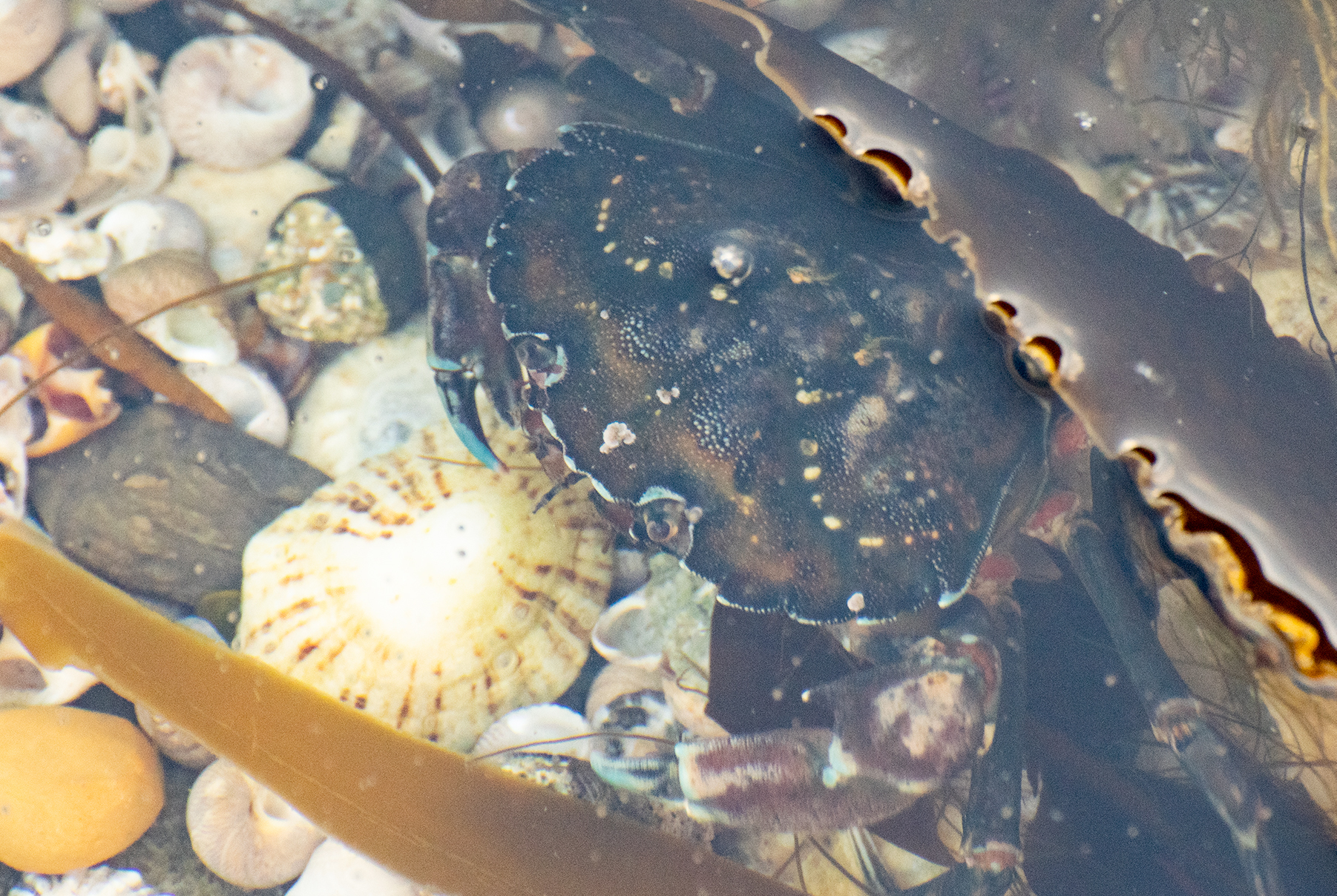

In short
The European green crab is a well-studied laboratory animal, which makes it a good test of a question worth asking about any organism: how much of its sensory front end can actually be computed rather than assumed? The answer turned out to be a tool that spends most of its time saying no.
The European green crab (Carcinus maenas) is unusual among invasive species in being a classic laboratory animal. That makes it a test of a question worth asking about any organism: how much of its sensory front end can be computed rather than assumed?
Not a simulator. A simulator implies you turn a crank and get behaviour out. This is narrower: for a given stimulus it answers how much arrives at a receptor, in what format that receptor passes it on, and where it goes — and refuses when the number underneath does not exist. The most common output is a refusal.
The design rule
Every constant carries its provenance: measured in this species, measured in a surrogate, derived from physics, or assumed. That sounds like bookkeeping. It did the work.
The tags caught six errors already in the model, every one from reading a summary instead of a source. Two examples:
- A trap statistic entered as “entry success rises from 16% to 59%.” Those are two different measurements — one the fraction of attempts that succeed, the other a percentage increase in catch from a modification. The second does not continue the first, and the best modification was not the one being quoted.
- A receptor threshold was carried as a single value where the study reports a range. The single number was the low end.
The rule that generates the rest: an abstract is not a paper. A source read only at abstract may be cited as existing; nothing may be said about what it measured. That constraint is load-bearing below, and it is marked where it bites.
Mechanical senses — the measured part
The strongest ground, because there is a real transfer function for this species. Mouthpart setae recordings give displacement thresholds in micrometres and, more usefully, the coding: spike count scales with displacement amplitude, interspike interval with velocity, and roughly half the cells are directionally sensitive.
That detail is what made the first version wrong. Those setae are tactile receptors for handling prey, not distance detectors, and far-field stimuli were being scored against them. The tool now raises a scope flag on any far-field verdict from that row.
The receptor that is for water motion is a different one — sensory hairs on the chelae, studied in crayfish. A joint organ in the walking leg has been described in green crab itself, the response of intact animals to substrate vibration tested directly, decapod acoustic detection reviewed as a field, an evoked-potential study in American lobster asks which organ is responsible, and a consolidated review of green crab sensory biology exists.
Where the abstract-only rule bites: of the seven sources in this section, two were read at full text. For the other five: they exist, and the question they asked is stated, not what they found. So the surrogate threshold the tool uses for the water-motion channel is a number I cannot attribute, and it is tagged as a surrogate for that reason.
The physics that decides most of it
Near-field falloff. A small oscillating body in water produces a field falling off as 1/r³ if it oscillates back and forth, 1/r² if it changes volume. The cube law is brutal: a thousand times more source amplitude buys ten times the range. Ordinary prey is a centimetre-scale cue; only a large struggling animal or another crab reaches decimetres.
Displacement is not pressure. Particle displacement equals velocity over 2πf, so for a given sound pressure a kilohertz signal carries far less displacement than a hundred-hertz one. High-frequency sound is displacement-poor, and crabs detect displacement.
Together these explain why the acoustic route keeps failing and the chemical route keeps winning: a plume falls off as 1/r, and the olfactory threshold is low.
What prey actually emit
The reference dataset for benthic invertebrate sound gives calibrated source levels for scallops, limpets, urchins and crustaceans.
Converted to particle displacement and solved against the crab’s threshold, none reaches a crab at more than millimetres — and every sound in that dataset peaks between 5 and 49 kHz, while the analysis band was filtered from 2 kHz upward. The corpus was built for hydrophone monitoring, not prey detection, and the crab’s band was removed before analysis. A null there is unavailable, not absent.
The promising cue is not a sound. Porewater pressure signals from infaunal activity have been recorded directly in sediment, and the irrigation timing of three tellinid bivalves — including a Pacific Northwest clam that is real green crab prey — has been measured.
A slow hydraulic signal, not an acoustic one, and the only prey cue here with a field detection range measured on relevant species.
Chemistry, which out-ranges everything
Modelled as a plume, chemical detection spans roughly three orders of magnitude more distance than any mechanical cue. Two anatomically separate systems do different jobs — olfaction on the antennules, contact chemoreception on the dactyls, where the gustatory organs of this species have been characterised electrophysiologically.
Abstract only, so the threshold separation between the two — which is what the tool runs on — is a sourced parameter in the model and is not stated here.
One deliberate refusal: a chemical stimulus is not a scalar. You cannot hand it a single concentration and get a receptor response, because mixtures cross-adapt and receptors encode a ratio against background rather than an absolute. Single-compound dose-response is enabled; mixtures raise an exception.
The female sex pheromone has been identified, and later work with it produced the most interesting behavioural result in this review.
Males presented with a pheromone-treated dummy female showed a mating response 87% of the time under ambient conditions and 40% under ship-noise playback — while the time taken to respond to the pheromone did not change significantly. Noise interfered with completing the behaviour, not with detecting the signal. That dissociation is worth more than either number alone.

Electric and magnetic — where the tool says no
The two channels refused outright, and the refusals are its highest-confidence outputs.
Electric. No electroreceptor has been identified in any crustacean, and none sought in this species. Not a modelling gap; the state of the field. The physics is unambiguous: prey bioelectric fields measured at microvolt scale with the electrode under a millimetre from tissue, and the authors state the voltage from invertebrates was too weak to record away from the source.
A behavioural sensitivity figure exists for a freshwater crayfish — a surrogate, different order, fresh water.
The tool quotes named surrogates and will not produce a crab number.
Welfare, which is a different question from detection. This species has nociceptors. Acetic acid on every soft tissue tested — eyes, antennae, antennules, claws, leg joints — produced a central nervous response, longer-lasting and lower in amplitude than a touch.
And green crabs learn to avoid a place where they are shocked. Given two shelters, with a 10 V, 180 Hz, 200 ms shock delivered every 5 s through wires on the legs in one of them, they learned to walk left or right to reach the other. The voltage was set below the level at which a single shock made a crab drop a leg, and some dropped a wired leg anyway.
Both read in full. That shock was contact current through the legs, not a field in water, so it gives the tool no field threshold and changes no number above. What it changes is the expectation: current is aversive to this animal, so an electric lure should be expected to repel as well as attract. The welfare limit the tool enforces — crayfish forced electrotaxis, about 4 V/m — marks where current forces movement, not where it becomes unpleasant.
Magnetic. One directly relevant result: juvenile green crabs exposed to static magnetic fields at strengths relevant to submarine power cables, females spending substantially more time in exposed zones while males showed no consistent preference.
A real, sex-specific response in this species — and a static-field spatial preference, not a compass, and not a receptor. Nobody has located the transducer.
The obvious confound, stated plainly. Helmholtz coils dissipate heat and crabs are thermotactic. Working the published coil geometry through a thermal model gives, at the strongest field over the exposure period, roughly 20 W dissipated, a 0.58 K gradient across the tank and a 0.30 K bulk rise — small, but not obviously below what an animal can detect, and no behavioural thermal-discrimination threshold for this species could be found to compare against. The model returns a number and refuses a verdict.
One weak argument against the thermal explanation: ohmic heating scales with the square of the current, so the confound is about ten times larger at the strongest field than at the intermediate one — while the reported attraction was strongest at the intermediate field. Confound and effect run in opposite directions. A thermocouple in the tank would settle it, and that is the cheapest experiment anywhere in this review.
The usual comparison is the spiny lobster, the standard invertebrate magnetoreception system.
Here the abstract-only rule bites hardest: all three read at abstract, so their results are not characterised. What can be said is about the shape of the literature rather than its contents — the receptor cells have not been located and characterised in that animal either. Mapping a mechanism from one order of crustaceans onto another, across more than two hundred million years of divergence, when the source species’ anatomy is itself unresolved, produces a hypothesis wearing borrowed credibility. The tool returns unavailable and says why.
How the native crabs compare
The most informative part, because the comparison cannot be run.
Across eight receptor channels and five species, green crab has measured values in five channels and a described-but-unmeasured organ in two. For Dungeness, red rock, graceful rock and yellow shore crab: two measured thresholds, both in Dungeness — a behavioural detection threshold for a prey extract, and behavioural salinity detection measured by antennular flicking.
Both at abstract only, so those are descriptions of what was measured, not of what was found — the model carries them with the same tag. (A third record sits off the matrix entirely: dactyl chemo- and mechanoreceptor recordings in the kelp crab, not among the five.)
Two filled cells out of thirty-two, and the comparison still cannot be run — for a smaller reason than an empty literature. Those are behavioural thresholds, in grams per litre and parts per thousand. Every green crab value is single-unit electrophysiology, in micrometres or molar. Not the same quantity, so one row would be a category error rather than a comparison.
That is the state of the literature, not a gap in the modelling. Green crab is a classic laboratory animal; the natives are commercially and ecologically important animals whose sensory physiology has largely not been measured.
What can be compared is everything except the senses, and there the differences are substantial and documented: salinity tolerance, depth and zonation, body size, moult timing, tolerance of emersion and hypoxia.
The first was read at full text and the rest at abstract, which is why this section names questions rather than answers.
The genetics, and what is actually there
Looking for a genetic basis for the reproductive advantage — some identified difference explaining why it out-reproduces the natives. There isn’t one, and the absence is informative.
The adaptive-genomics literature for this species is real and substantial. What it is about is temperature: cold tolerance, thermal adaptation, a chromosomal inversion, and the relationship between genotype and thermal plasticity.
Read at abstract only, so their findings are not characterised. But that the surveyed literature concerns thermal physiology and not reproduction or sensory biology is an observation about the literature, and it can be made.
So the honest account of why green crab out-reproduce the natives is life-history and tolerance, not a gene: longer breeding season, earlier maturity at smaller size, two broods a year where conditions allow, and sperm storage such that one fertilisation can serve more than one clutch. Note that reproducing more is not the same as mating more — with sperm storage the two can move in opposite directions.
What the tool is for
The most-used outputs are refusals: no electric readout, no magnetic readout, no mixture readout, no cross-species comparison, no sex difference in transduction. Sex enters in one place — body size — because no measured threshold in this species differs by sex, and the tool will not invent one.
The value is not in the numbers. It is that they cannot drift: every constant is pinned by a test that fails if the figure is misquoted, and in one session those tests caught four errors that had entered from secondary summaries of paywalled sources — which is how this literature is normally read.
The most instructive failure was mine, not the literature’s. The claim that no native species had a single measured sensory channel was a strong negative drawn from a shallow search, and it was wrong; a deeper search turned up the two Dungeness thresholds immediately. A test had been pinning the wrong number in place, with a comment beside it admitting the value was stale. That is worse than an unchecked number, because it looks checked.
Correcting it nearly introduced a new error. The function answering which channels are comparable across species tested only whether a cell was marked measured. Filling the two Dungeness cells would have made two channels report comparable when the underlying quantities are not the same thing. It compares units now. A test that counts statuses will happily certify a category error, and the correction is what exposed it.
What would make it wrong: a measured audiogram for Carcinus maenas, Dungeness and red rock crab on one rig, showing receptor bands substantially different from the surrogate values used here. Most mechanical conclusions would need redoing. That measurement does not exist, and it is the single experiment that would change the most.
Corrections
2026-09-06. Three changes, none erasing anything above.
- The native-comparison section originally said “two measured chemosensory thresholds in a single species and nothing else.” The two are now cited by key, one is a salinity threshold rather than a prey-odour one, and “nothing else” was an overreach — a third native record exists off the matrix. Both are held at abstract only, so the post names what they measured and not what they measured it to be. The count of filled cells is unchanged at two of thirty-two, and the comparison remains un-runnable.
- “What the tool is for” gains the account of how that error survived a test, and of the second defect that correcting it exposed.
- The correction has been applied to the model itself, not only to this post.
2026-09-16. One addition, nothing erased: the electric section now carries the green-crab welfare evidence — nociceptive responses and learned shock avoidance — with a note that neither supplies a field threshold, so no number in the tool changed.
Version history 6 revisions
Generated from this site's git history. with Claude means the commit carries a co-author line for an Anthropic model: an LLM took part in that change, not necessarily in every word of it, and git cannot say which. The same history on GitHub →
-
v6 2026-09-16 07:56 Post: green crab welfare evidence in the electric section
- venkataraman2025- kasiouras2024- magee2013summary: >-The tool quotes named surrogates and will not produce a crab number.**Welfare, which is a different question from detection.** This species has nociceptors. Acetic acid on every soft tissue tested — eyes, antennae, antennules, claws, leg joints — produced a central nervous response, longer-lasting and lower in amplitude than a touch.{% include source.html key="kasiouras2024" %}And green crabs **learn to avoid a place where they are shocked.** Given two shelters, with a 10 V, 180 Hz, 200 ms shock delivered every 5 s through wires on the legs in one of them, they learned to walk left or right to reach the other. The voltage was set below the level at which a single shock made a crab drop a leg, and some dropped a wired leg anyway.{% include source.html key="magee2013" %}Both read in full. That shock was contact current through the legs, not a field in water, so it gives the tool **no field threshold** and changes no number above. What it changes is the expectation: current is aversive to this animal, so an electric lure should be expected to repel as well as attract. The welfare limit the tool enforces — crayfish forced electrotaxis, about 4 V/m — marks where current *forces* movement, not where it becomes unpleasant.**Magnetic.** One directly relevant result: juvenile green crabs exposed to static magnetic fields at strengths relevant to submarine power cables, **females spending substantially more time in exposed zones while males showed no consistent preference.**- The correction has been applied to the model itself, not only to this post.**2026-09-16.** One addition, nothing erased: the electric section now carries the green-crab welfare evidence — nociceptive responses and learned shock avoidance — with a note that neither supplies a field threshold, so no number in the tool changed. -
v5 2026-09-12 07:54 posts: inline source cards, and every post cut to the point
status: publishedinline_sources: truetier: C---The European green crab (*Carcinus maenas*) is unusual among invasive species in being a classic laboratory animal. That makes it agoodtest of a question worth asking about any organism: **how much of its sensory front end can be computed rather than assumed?**The thing I built is notNot a simulator. A simulator implies youcanturn a crank and get behaviour outthe other end.What this doesThis is narrower: for a given stimulus it answers **how much** arrives at a receptor, **in what format** that receptor passes it on, and **where** it goes — anditrefusesto answerwhen the number underneath does not exist.Calling it a *screening tool* is more honest than calling it a simulator, and the difference matters, because theThe most common output is a refusal.## The design rule: every number carries where it came fromEachEvery constantin the tool is tagged withcarries its provenance—: measured in this species, measured in a surrogatespecies, derived from physics, or assumed. That sounds like bookkeeping. Itturned out to be the part thatdid the work.Over the course of building it, theThe tags caught six errorsthat hadalreadymade it intoin the model, every oneof themfrom reading a summary instead of a source. Two examples, because they are the kind of thing that is invisible without the discipline:- A trap statistic enteredthe modelas "entry success rises from 16% to 59%." Those are two different measurements — oneisthe fraction of attempts that succeed{% include cite.html key="bergshoeff2018" %}, the otherisa percentage *increase in catch* from a modification{% include cite.html key="bergshoeff2019" %}. The second does not continue the first, and the best modification was not the one being quoted.{% include source.html key="bergshoeff2018" %} {% include source.html key="bergshoeff2019" %}- A receptor threshold was carriedin the modelas a single valuewhenwhere theunderlyingstudy reports a range{% include cite.html key="schmidt1989" %}. The single number was the low endof it.**The rule that generates the rest:**an abstract is not a paper.** A source read only at abstractcanmay be cited as existing, but; nothing may be said about what it measured. That constraint is load-bearingin what followsbelow, andIithaveis marked where it bites.##The mechanicalMechanical senses — the measured partthat is genuinely measuredThe strongest groundis mechanoreception, because there is a real transfer function for this species.Recordings from the mouthpartMouthpart setae recordings give displacement thresholds in micrometres,and—, moreuseful —usefully, the*coding*: spike count scales with displacement amplitude, interspike interval with velocity, and roughly half the cells are directionally sensitive{% include cite.html key="garm2005" %}.{% include source.html key="garm2005" %}**Thatlastdetail is what made the first versionof the toolwrong.** Those setae are **tactile** receptors for handling prey, not distance detectors, andI had been scoringfar-field stimuli were being scored against them. The tool now raises a scope flag on any far-field verdict from that row, because the answer it would give is meaningless.The receptor that *is* for water motion is a different one:— sensory hairs on the chelae, studied in crayfish{% include cite.html key="tautz1980" %}. A joint organ in the walking leg has been described in green crab itself{% include cite.html key="burke1954" %}, thebehaviouralresponse of intact animals to substrate vibrationhas beentested directly{% include cite.html key="aimon2021" %},anddecapod acoustic detectionhas beenreviewed as a field{%,include cite.html key="popper2001" %}. Anan evoked-potential study intheAmerican lobster asks which organ isactuallyresponsible{% include cite.html key="jzquel2021" %}, and a consolidated review of green crab sensory biology exists{% include cite.html key="jury2024" %}.{% include source.html key="tautz1980" %} {% include source.html key="burke1954" %} {% include source.html key="aimon2021" %} {% include source.html key="popper2001" %} {% include source.html key="jzquel2021" %} {% include source.html key="jury2024" %}**Where the abstract-only rule bites, and it bites here:** of the seven sources in this section,Itwohavewere readtwoat full text. For the other fiveI can tell you: they exist, andwhatthe question they asked—is stated, not what they found. **So the surrogate threshold the toolactuallyuses for the water-motion channel is a number Iam not in a position tocannot attribute**, andtheittool carries itis tagged as a surrogate forexactlythat reason.## The physics that decides most of itTwo pieces of arithmetic ended up governing nearly every conclusion.**Near-field falloff.** A small oscillating body in water produces a fieldthat fallsfalling off as 1/r³ if it oscillates back and forth,or1/r² if it changes volume. The cube law is brutal: a thousand times more source amplitude buys ten times the range.Working through plausibleOrdinary preysources, ordinary prey turns out to beis a centimetre-scale cue; only a large struggling animal or another crab reaches decimetres.**Displacement is not pressure.** Particle displacement equals velocitydivided byover 2πf, so for a given sound pressure a kilohertz signal carries far less displacement than a hundred-hertz one. High-frequency sound is displacement-poor, and crabs detect displacement.ThoseTogethertwo togetherthese explain why the acoustic route keeps failing,andthey are also whythe chemical route keeps winning: a plume falls off as 1/r, and the olfactory threshold is low.## What prey actually emitHaving built the receiver side, the obvious next question is what is available to receive.The reference dataset for benthic invertebrate sound gives calibrated source levels for scallops, limpets, urchins and crustaceans.{% include source.html key="coquereau2016" %}The reference dataset for benthic invertebrate sound gives calibrated source levels for scallops, limpets, urchins and crustaceans{% include cite.html key="coquereau2016" %}. Converting eachConverted to particle displacement andsolvingsolvedforagainst the crab's threshold, noneof itreaches a crab at more than millimetres — and every sound in that dataset peaks between 5 and 49 kHz, while the analysis band was filtered from 2 kHz upward. **The corpus was built for hydrophone monitoring, notforprey detection, and the crab's band was removed before analysis.** A null there is unavailable, not absent.The promising cuethat does look promisingis not a soundat all. Porewater pressure signalsgenerated byfrom infaunal activity have been recorded directly in sediment{% include cite.html key="wethey2005" %}, and the irrigation timing of three tellinid bivalves — including a Pacific Northwest clam that is real green crab prey — has been measuredin detail{% include cite.html key="volkenborn2012" %}. That is a slow hydraulic signal, not an acoustic one, and it is the only prey cue in this review with a field detection range measured on relevant species.{% include source.html key="wethey2005" %} {% include source.html key="volkenborn2012" %}A slow hydraulic signal, not an acoustic one, and the only prey cue here with a field detection range measured on relevant species.## Chemistry, which out-ranges everythingModelled as a plume, chemical detection spans roughly three orders of magnitude more distance than any mechanical cue.The receptor side has twoTwo anatomically separate systemsdoingdo different jobs — olfaction on the antennules,andcontact chemoreception on the dactyls, where the gustatory organs of this species have been characterised electrophysiologically{% include cite.html key="schmidt1989" %}. **I have that paper at abstract only, so the threshold separation between the two — which is what the tool actually runs on — is stated in the model as a sourced parameter and is not stated here.**{% include source.html key="schmidt1989" %}**Abstract only, so the threshold separation between the two — which is what the tool runs on — is a sourced parameter in the model and is not stated here.**TheOnetooldeliberaterefusesrefusal:one thing here, deliberately. Aa chemical stimulus is not a scalar. You cannot hand it a single"concentration"and get a receptor response, because mixtures cross-adapt and receptors encode a ratio against background rather than an absolute. Single-compound dose-response is enabled; mixtures raise an exception.The female sex pheromone has been identified, and later work with it produced the most interesting behavioural result in this review.{% include source.html key="hardege2011" %} {% include source.html key="rising2022" %}The female sex pheromone in this species has been the subject of an identification study{% include cite.html key="hardege2011" %}, and later work using it produced the single most interesting behavioural result in this review: malesMales presented with a pheromone-treated dummy female showed a mating response 87% of the time under ambient conditions and 40% under ship-noise playback, a significant drop— while the *time taken to respond to the pheromone* did not change significantly{% include cite.html key="rising2022" %}. **Noise interfered with completing the behaviour, not with detecting the signal.** That dissociation is worth more than either number alone.## Electric and magnetic — where the tool says noThese are theThe two channelsthe tool refusesrefused outright, and the refusals aretheits highest-confidence outputsin it.**Electric.** No electroreceptor has been identified in any crustacean, and nonehas beensought in this species.That is notNot a modelling gap;it isthe state of the field. The physicssideis unambiguous: prey bioelectric fieldsweremeasured at microvolt scale with the electrodeless thanunder a millimetre fromthetissue, and the authors stateplainly thatthe voltage from invertebrates was too weak to record away from the source{% include cite.html key="bedore2013" %}. A behavioural sensitivity figure exists for a freshwater crayfish{% include cite.html key="patullo2010" %} — a surrogate, from a different order, in fresh water. The tool will quote named surrogates and will not produce a crab number.{% include source.html key="bedore2013" %}A behavioural sensitivity figure exists for a freshwater crayfish — a surrogate, different order, fresh water.{% include source.html key="patullo2010" %}The tool quotes named surrogates and will not produce a crab number.**Magnetic.**There is aOne directly relevant result: juvenile green crabswereexposed to static magnetic fields at strengths relevant to submarine power cables,and**femalesspentspending substantially more time intheexposed zones while males showed no consistent preference.**{% include cite.html key="james2025" %}. That is a real, sex-specific response in this species — and it is a static-field spatial preference, not a compass, and not a receptor. Nobody has located the transducer.{% include source.html key="james2025" %}A real, sex-specific response in this species — and a static-field spatial preference, not a compass, and not a receptor. Nobody has located the transducer.**And there is a confound worth stating plainly, because it is theThe obviousoneconfound, stated plainly.** Helmholtz coils dissipate heat,and crabs are thermotactic. Working the published coil geometry through a thermal model gives, at the strongest field over the exposure period, roughly **20 W dissipated, a 0.58 K gradient across the tank and a 0.30 K bulk rise** — small, but not obviously below what an animal can detect, andI could not find ano behavioural thermal-discrimination threshold for this species could be found to compareitagainst.So theThe model returns a number and refuses a verdict.Onethingweakdoes argueargument against the thermal explanation, weakly: ohmic heating scales with the square of the current, so the confound is about ten times larger at the strongest field than at the intermediate one — while the reported attraction was *strongest at the intermediate field*.The confoundConfound andtheeffect run in opposite directions. **A thermocouple in the tank would settle it, and that is the cheapest experiment anywhere in this review.**The usual comparison is the spiny lobster, the standard invertebrate magnetoreception system.The usual comparison is the spiny lobster, which is the standard invertebrate magnetoreception system{% includecitesource.html key="lohmann1984" %} {% includecitesource.html key="boles2003" %} {% includecitesource.html key="ernst2016" %}.**Here the abstract-only rule bites hardest:**Iallhavethree readthose threeat abstract, soItheirwillresults are notcharacterise their resultscharacterised. WhatIcanwillbesaysaid isa statementabout the shape of the literature rather than its contents — the receptor cellsthemselveshave not been located and characterised in that animal either. Mapping a mechanism from one order of crustaceans onto another, across more than two hundred million years of divergence, when the source species' anatomy is itself unresolved, produces a hypothesis wearing borrowed credibility. The tool returns unavailable and says why.## How the native crabs compareComparing green crab to the Pacific Northwest natives was the point at which the exercise becameThe most informative part, because **the comparison cannot be run.**Across eight receptor channels and five species,thegreen crab has measured values in five channels and a described-but-unmeasured organ in two. For Dungenesscrab, red rockcrab, graceful rockcraband yellow shore crab, I found: **two** measured thresholds, both in Dungeness.One establishes— a behavioural detection threshold for a prey extract{%,include cite.html key="pearson1979" %}; the other,and behavioural salinity detection measured by antennular flicking{% include cite.html key="sugarman1983" %}. **I have both at abstract only, so those are descriptions of what was measured, not of what was found** — the model carries the values with the same tag. (A third record sits off this matrix entirely: dactyl chemo- and mechanoreceptor recordings in the kelp crab, a species not among the five.){% include source.html key="pearson1979" %} {% include source.html key="sugarman1983" %}**Both at abstract only, so those are descriptions of what was measured, not of what was found** — the model carries them with the same tag. (A third record sits off the matrix entirely: dactyl chemo- and mechanoreceptor recordings in the kelp crab, not among the five.)**Two filled cells out of thirty-two, and the comparison still cannot be run** —butfor adifferent and muchsmaller reason than an empty literature. Those are *behavioural* thresholds, in grams per litre and parts per thousand. Every green crab value is *single-unit electrophysiology*, in micrometres or molar.They are notNot the same quantity, soputting them inone row would be a category error rather than a comparison.**That is the state of the literature, not a gap in the modelling.** Green crab is a classic laboratory animal; the natives are commercially and ecologically important animals whose sensory physiology has largely not been measured.What *can* be compared is everything except the senses — and there the differences are substantial and well documented{% include cite.html key="young2019" %}: salinity tolerance, depth and zonation, body size, moult timing, and tolerance of emersion and hypoxia. Subadult Dungeness use the littoral zone in ways that matter for any comparison drawn from trap data{% include cite.html key="holsman2006" %}, red rock crab emersion physiology has been measured in situ{% include cite.html key="defur1983" %}, settlement and emigration behaviour has been studied in green crab{% include cite.html key="moksnes2003" %}, predatory capability has been compared directly between green crab and red rock crab on a native clam{% include cite.html key="nicol2025" %}, and the effect of a recovering apex predator on green crab abundance has been examined{% include cite.html key="jeppesen2024" %}.What *can* be compared is everything except the senses, and there the differences are substantial and documented: salinity tolerance, depth and zonation, body size, moult timing, tolerance of emersion and hypoxia.{% include source.html key="young2019" %} {% include source.html key="holsman2006" %} {% include source.html key="defur1983" %} {% include source.html key="moksnes2003" %} {% include source.html key="nicol2025" %} {% include source.html key="jeppesen2024" %}I have read theThe firstofwasthoseread at full text and the rest at abstract, which is why thisparagraphsection names questions rather than answers.## The genetics, and what is actually thereI went lookingLooking for a genetic basis for thegreen crab'sreproductive advantage — some identified differencethat would explainexplaining why it out-reproduces the natives. **There isn't one, and the absence is informative.**The adaptive-genomics literature for this species is real and substantial. What it is *about* is temperature: cold tolerance, thermal adaptation, a chromosomal inversion, and the relationship between genotype and thermal plasticity{% include cite.html key="tepolt2020" %}{% include cite.html key="thia2021" %}{% include cite.html key="venkataraman2025" %}. I have read these at abstract only and will not characterise their findings. But the observation that the surveyed literature concerns thermal physiology and not reproduction or sensory biology is an observation about the literature, and I can make it.{% include source.html key="tepolt2020" %} {% include source.html key="thia2021" %} {% include source.html key="venkataraman2025" %}Read at abstract only, so their findings are not characterised. But that the surveyed literature concerns thermal physiology and not reproduction or sensory biology is an observation about the literature, and it can be made.So the honest account of why green crab out-reproduce the natives is life-history and tolerance, not a gene:alonger breeding season, earlier maturity at smaller size, two broods a year where conditions allow, and sperm storage such that one fertilisation can serve more than one clutch{% include cite.html key="young2019" %}. Notealsothat *reproducing* more is not the same as *mating* more — with sperm storage,the two can move in opposite directions.## What the tool is forThe most-used outputs are refusals: no electric readout, no magnetic readout, no mixture readout, no cross-species comparison, no sex difference in transduction. Sex entersthe modelinexactlyone place — body size — because no measured threshold in this species differs by sex, and the tool will not invent one.That is a strange thing to build on purpose, and it is the part I would defend.The value is not in the numbersit produces. It is thatthe numbersthey cannot drift: every constant is pinned by a test that fails if the figure is misquoted, and in oneworkingsession those tests caught four errors that had enteredthe modelfrom secondary summaries of paywalled sources — which isexactlyhow this literature is normally read.**The most instructive failure, though,was mineand, not the literature's.** The claimabove —that no native species had a single measured sensory channel—was a strong negative drawn from a shallow search, and it was wrong; a deeper search turned up the two Dungeness thresholds immediately.**A test had been pinning the wrong number in place**, with a comment beside it admitting the value was known to be stale. That is worse than an unchecked number, because it looks checked.**A test had been pinning the wrong number in place**, with a comment beside it admitting the value was stale. That is worse than an unchecked number, because it looks checked.And correctingCorrecting it nearly introduced a new error. The function answering *which channels are comparable across species* tested only whether a cell was marked measured. Filling the two Dungeness cells would have made two channels reportascomparable when the underlying quantities are not the same thing. It compares units now. **A test that counts statuses will happily certify a category error**, and the correction is what exposed it.**What would make it wrong:**ifa measured audiogram for *Carcinus maenas*, Dungeness and red rock crab on one rig,showed theshowing receptor bandsto besubstantially different from the surrogate values used here,.most of theMost mechanical conclusions would need redoing. That measurement does not exist, and it is the single experiment that would change the most.---## Corrections**2026-09-06.** Three changes, noneof which eraseerasing anything above.- The native-comparison section originally saidI had found*"two measured chemosensory thresholds in a single species and nothing else."* The two are now**cited by key**{% include cite.html key="pearson1979" %}{% include cite.html key="sugarman1983" %}, oneof themis a salinity threshold rather than a prey-odour one, and **"nothing else" was an overreach** — a third native record exists off the matrix. Both are held at abstract only, so the post names what they measured and not what they measured it to be. The count of filled cells is unchanged at two of thirty-two, and the comparison remains un-runnable.-The**"What the tool is for"**sectiongains the account of how that error survived a test, and of the second defect that correcting it exposed.- The correction has been applied to the model itself, not only to this post. -
v4 2026-09-12 07:08 post: a hive and a cortex, described the same way
The European green crab (*Carcinus maenas*) is unusual among invasive species in being a classic laboratory animal. That makes it a good test of a question worth asking about any organism: **how much of its sensory front end can be computed rather than assumed?**The thing I built is not a simulator. A simulator implies you can turn a crank and get behaviour out the other end. What this does is narrowerand, I think, more useful: for a given stimulus it answers **how much** arrives at a receptor, **in what format** that receptor passes it on, and **where** it goes — and it refuses to answer when the number underneath does not exist. Calling it a *screening tool* is more honest than calling it a simulator, and the difference matters, because the most common output is a refusal.## The design rule: every number carries where it came from -
v3 2026-09-06 19:43 Post: cite the two Dungeness thresholds, and log the correction
- holsman2006- pearson1979- sugarman1983- defur1983Comparing green crab to the Pacific Northwest natives was the point at which the exercise became most informative, because **the comparison cannot be run.**Across eight receptor channels and five species, the green crab has measured values in five channels and a described-but-unmeasured organ in two. For Dungeness crab, red rock crab, graceful rock crab and yellow shore crab, I found **two** measuredchemosensorythresholds,thresholdsboth in Dungeness. One establishes asinglebehaviouralspeciesdetectionandthresholdnothingforelsea prey extract{% include cite.htmlNokey="pearson1979"channel%};isthe other, behavioural salinity detection measuredinbytwoantennularspeciesflicking{%inincludecommensurablecite.htmlunitskey="sugarman1983" %}. **I have both at abstract only, sonothosechannelarecandescriptionsbeofcomparedwhat was measured, not of what was found** — the model carries the values with the same tag. (A third record sits off this matrix entirely: dactyl chemo- and mechanoreceptor recordings in the kelp crab, a species not among the five.)**Two filled cells out of thirty-two, and the comparison still cannot be run** — but for a different and much smaller reason than an empty literature. Those are *behavioural* thresholds, in grams per litre and parts per thousand. Every green crab value is *single-unit electrophysiology*, in micrometres or molar. They are not the same quantity, so putting them in one row would be a category error rather than a comparison.**That is the state of the literature, not a gap in the modelling.** Green crab is a classic laboratory animal; the natives are commercially and ecologically important animals whose sensory physiology has largely not been measured.That is a strange thing to build on purpose, and it is the part I would defend. The value is not in the numbers it produces. It is that the numbers cannot drift: every constant is pinned by a test that fails if the figure is misquoted, and in one working session those tests caught four errors that had entered the model from secondary summaries of paywalled sources — which is exactly how this literature is normally read.**The most instructive failure, though, was mine and not the literature's.** The claim above — that no native species had a single measured sensory channel — was a strong negative drawn from a shallow search, and it was wrong; a deeper search turned up the two Dungeness thresholds immediately. **A test had been pinning the wrong number in place**, with a comment beside it admitting the value was known to be stale. That is worse than an unchecked number, because it looks checked.And correcting it nearly introduced a new error. The function answering *which channels are comparable across species* tested only whether a cell was marked measured. Filling the two Dungeness cells would have made two channels report as comparable when the underlying quantities are not the same thing. It compares units now. **A test that counts statuses will happily certify a category error**, and the correction is what exposed it.**What would make it wrong:** if a measured audiogram for *Carcinus maenas*, Dungeness and red rock crab on one rig showed the receptor bands to be substantially different from the surrogate values used here, most of the mechanical conclusions would need redoing. That measurement does not exist, and it is the single experiment that would change the most.---## Corrections**2026-09-06.** Three changes, none of which erase anything above.- The native-comparison section originally said I had found *"two measured chemosensory thresholds in a single species and nothing else."* The two are now **cited by key**{% include cite.html key="pearson1979" %}{% include cite.html key="sugarman1983" %}, one of them is a salinity threshold rather than a prey-odour one, and **"nothing else" was an overreach** — a third native record exists off the matrix. Both are held at abstract only, so the post names what they measured and not what they measured it to be. The count of filled cells is unchanged at two of thirty-two, and the comparison remains un-runnable.- The **"What the tool is for"** section gains the account of how that error survived a test, and of the second defect that correcting it exposed.- The correction has been applied to the model itself, not only to this post. -
v2 2026-09-06 07:55 Post: add image and the thermal-confound amendment
claims:image: /assets/posts/european-green-crab.jpgimage_alt: >-A European green crab on wet sand, chelae raised, its carapace mottled greenand its walking legs spread.image_credit: Victor Hengimage_license: CC0image_license_url: https://creativecommons.org/publicdomain/zero/1.0/image_source_url: https://commons.wikimedia.org/wiki/File:Carcinus_maenas_138761951.jpgcitations:**Magnetic.** There is a directly relevant result: juvenile green crabs were exposed to static magnetic fields at strengths relevant to submarine power cables, and **females spent substantially more time in the exposed zones while males showed no consistent preference**{% include cite.html key="james2025" %}. That is a real, sex-specific response in this species — and it is a static-field spatial preference, not a compass, and not a receptor. Nobody has located the transducer.**And there is a confound worth stating plainly, because it is the obvious one.** Helmholtz coils dissipate heat, and crabs are thermotactic. Working the published coil geometry through a thermal model gives, at the strongest field over the exposure period, roughly **20 W dissipated, a 0.58 K gradient across the tank and a 0.30 K bulk rise** — small, but not obviously below what an animal can detect, and I could not find a behavioural thermal-discrimination threshold for this species to compare it against. So the model returns a number and refuses a verdict.One thing does argue against the thermal explanation, weakly: ohmic heating scales with the square of the current, so the confound is about ten times larger at the strongest field than at the intermediate one — while the reported attraction was *strongest at the intermediate field*. The confound and the effect run in opposite directions. **A thermocouple in the tank would settle it, and that is the cheapest experiment anywhere in this review.**The usual comparison is the spiny lobster, which is the standard invertebrate magnetoreception system{% include cite.html key="lohmann1984" %}{% include cite.html key="boles2003" %}{% include cite.html key="ernst2016" %}. -
v1 2026-09-06 07:43 Post: building a sensory screening tool for the European green crab
v1: the original version, as first committed. Read it on GitHub →