September 25, 2026 · Audio-evoked potentials · v4
A spiking network built to lose: what it would and would not remember
A small, biologically grounded network was asked to store sounds and play them back. It could not. Along the way it showed which habituation mechanisms keep a stimulus-specific memory, and where a published single-cell model parts ways with the cell it describes.
- [SPEC]
- 4 resolved sources

In short
In simulation, synaptic depletion never kept a sound-specific memory, and only plasticity gated by the receiving cell did. A published receptor model drained untrained responses under a protein-synthesis block, where the real cell does not.
Everything below is a result about a computer model with chosen parameters. None of it is a measurement of a brain, an animal or a cell, and the tier says so. The code, every preregistered plan and every raw output are in a public repository: polarizetech/neural-memory.
The question
Could a network of spiking neurons, with synapses that tag and consolidate the way published models describe, store several sounds at once and play them back later from its own activity?
The project was set up to fail visibly. Every mechanism has an off switch, every result sits beside the same run with that mechanism removed, and a plain reservoir network is always run alongside as a baseline.
The tape did not work
Sound went in readably: a linear decoder recovered the input envelopes from the network’s activity while it listened. Nothing came back out. At every delay, and with every way of prompting recall that was tried, the decoded output matched the stored sound no better than it matched sounds the network had never heard. The plain reservoir encoded better.
An early result looked like a partial success: which stored sound was dominant at a given moment could be read from the order in which cells fired, 77% of the time where shuffled labels reached 57%. A later code review showed that ordering was measured while the sound was playing and was driven mostly by the input itself. It says the cells followed the input, not that the network kept anything.
The weight changes explain the failure. What the network wrote into its synapses was set by which cells happened to fire hardest, not by what they heard. A weight change predicted from any of twenty sounds the network never heard matched the real one as well as the played sound’s did.
Habituation as memory
The project then asked a smaller question. Repeated sounds evoke smaller responses. Is that fading a memory of the particular sound, or just fatigue?
Four mechanisms were compared in a small auditory network, each with its own switch:
- depletion of the input synapses;
- depression of a synapse only when the receiving cell also fires;
- inhibition that learns, using a rule of the form published in 4;
- receptor removal and replacement, as modelled for a single-celled organism 1.
Two experiments were preregistered: predictions, pass criteria and code were fixed in git before anything ran. Both closed as failures, because some predictions missed. What they showed:
Depletion kept no sound-specific memory. At no delay, from 2 seconds to 90 minutes, did it suppress the trained sound more than a different one. The main reason is in the ear model. At a normal listening level, the least-similar of twenty random test sounds still overlapped the trained one by 0.59 in the simulated auditory nerve, on a scale where 1 is identical. Depleting shared input fibres cannot tell the two apart.
Only plasticity gated by the receiving cell was specific. Depression that needed the receiving cell to fire picked out the trained sound 30 minutes later. The learned inhibition suppressed the trained sound too, and removing that inhibitory pathway undid all of it. Its specificity was limited by the same 0.59 overlap.
A model that drains where the cell does not
The fourth mechanism reproduces a published model of habituation in Stentor, a single-celled organism. In that model, stimulated receptors are pulled inside the cell and then recycled or destroyed, and new receptors are made continuously 1. In real cells, blocking protein synthesis made habituation faster and memory longer, while untrained cells given the same drug kept responding normally 2.
Run with the published model’s own rates, and the paper’s time step read as one minute (the paper states no unit), the block did not do that here:
- untrained responses fell by 32% after 20 minutes and 79% after 90 minutes;
- the extra memory the block produced was at most 1.4 points of suppression.
The published model has basal loss of surface receptors, so a synthesis block drains untrained cells in the model too. There the drain is hidden by a hard threshold: a cell far above its contraction threshold keeps contracting while its receptors run down. A readout without that threshold, like this network’s, exposes it. In this model, the cell’s normal untrained response depends on the threshold, not on the receptor pool. Whether that holds in the organism is a question for an experiment, not this simulation.
Spacing did not help
In roundworms trained at 60-second intervals, long-term habituation followed training split into blocks with hour-long rests. Training all at once lowered next-day responses too, but only the spaced group responded significantly less on the second day than on the first 3.
None of the mechanisms reproduced a spacing benefit. With the same number of presentations, spaced training left less suppression than massed training in the receptor and learned-inhibition models, and no difference for depletion. (The excitatory-depression model also favoured massed training, but a later review found its untrained comparison network drifts during a long schedule, so that comparison is confounded.) Each mechanism has a single decay rate, so earlier blocks simply fade. A spacing effect seems to need a second, slower consolidation stage that none of these models has.
What would change these conclusions
- A test pair with genuinely low overlap in the auditory nerve (below about 0.2), at which depletion does keep a specific trace. The overlap limit is a property of this ear model at this level, not a general law.
- Adding a hard response threshold to the receptor model’s readout and finding the untrained response still drains.
- A single-timescale mechanism that nonetheless favours spaced training.
The project is paused here. Its findings, defects and the next experiments each would need are listed in the repository.
The sources, in the order the argument uses them
- rajan2025 (2025) A receptor-inactivation model for single-celled habituation in Stentor coeruleusCurrent Biology 35, 3327-3340.e4.
- rajan2026 (2026) Molecular pathways for learning in the single-cell Stentor coeruleusCurrent Biology 36, 2367-2381.e9.
- beck1997 (1997) Long-term habituation is produced by distributed training at long ISIs and not by massed training or short ISIs inCaenorhabditis elegansAnimal Learning & Behavior 25, 446-457.
- vogels2011 (2011) Inhibitory Plasticity Balances Excitation and Inhibition in Sensory Pathways and Memory NetworksScience 334, 1569-1573.
Every entry above was resolved against Crossref or PubMed by
polarizetech/research and copied here by machine. Citations are
referenced by key; no author, year or DOI on this page was typed by hand.
They appear in the order the argument uses them, not alphabetically. Any line
describing what a source contributes is the author's summary — the
bibliographic record above it is not.
Version history 4 revisions
Generated from this site's git history. with Claude means the commit carries a co-author line for an Anthropic model: an LLM took part in that change, not necessarily in every word of it, and git cannot say which. The same history on GitHub →
-
v4 2026-09-25 13:01 Post: link neural-memory (renamed from sim-neural-memory)
---Everything below is a result about a computer model with chosen parameters. None of it is a measurement of a brain, an animal or a cell, and the tier says so. The code, every preregistered plan and every raw output are in a public repository: [polarizetech/sim-neural-memory](https://github.com/polarizetech/sim-neural-memory).## The question -
v3 2026-09-25 08:52 Posts: lead images for the spiking-network and adaptive-preregistration posts
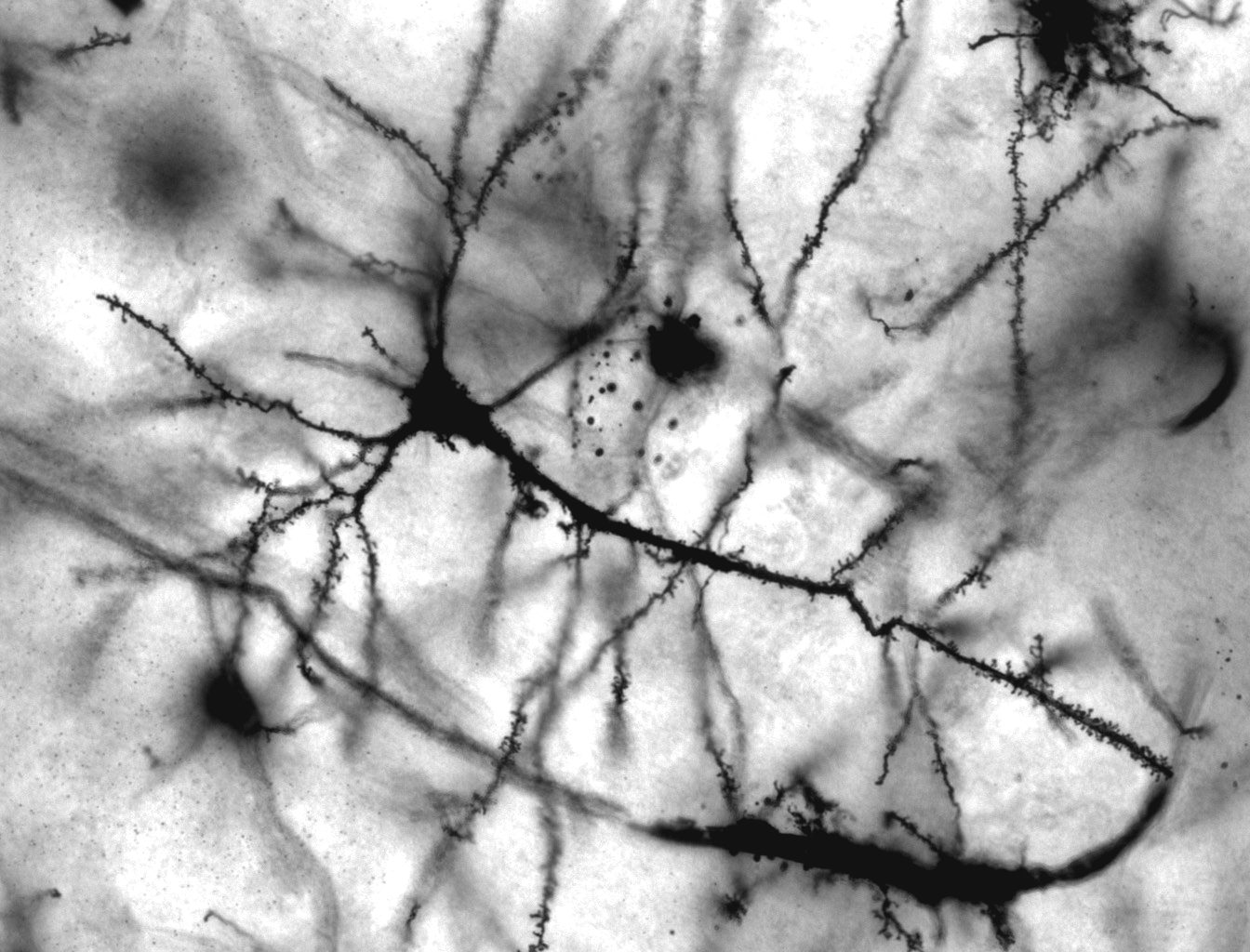
protein-synthesis block, where the real cell does not.image: /assets/posts/golgi-pyramidal-neuron.jpgimage_alt: >-A Golgi-stained pyramidal neuron from the human hippocampus at 40x magnification: a darkcell body with spine-covered dendrites branching across the field.image_credit: MethoxyRoxyimage_license: CC BY-SA 2.5image_license_url: https://creativecommons.org/licenses/by-sa/2.5/image_source_url: https://commons.wikimedia.org/wiki/File:Pyramidal_hippocampal_neuron_40x.jpg--- -
v2 2026-09-25 06:39 Post date: 07:00 so Jekyll does not skip it as future-dated
where a published single-cell model parts ways with the cell it describes.date: 2026-09-250907:00:00 -0600project: audio-evoked-potentials -
v1 2026-09-25 06:37 Publish: A spiking network built to lose
v1: the original version, as first committed. Read it on GitHub →