September 12, 2026 · Biosignal translation · v2
A hive and a cortex, described the same way
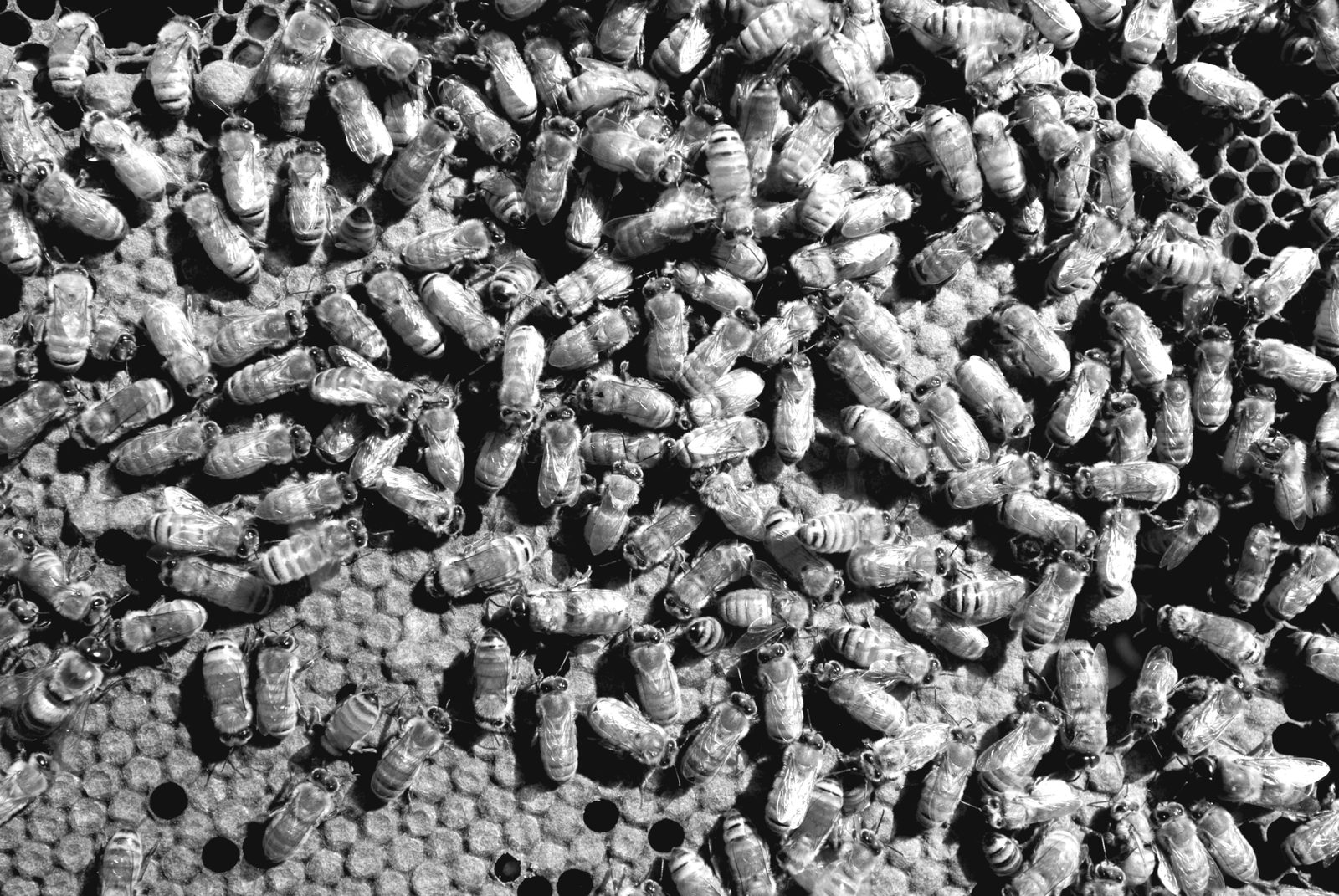
A honeybee colony choosing a nest and a cortical population choosing between two motions have carried the same formal description since 2009. What it covers, and where its own authors say it stops.
- [C]
- 11 resolved sources

In short
Inventory of an existing parallel, not a proposal. A swarm choosing a nest and a cortical population choosing a direction are modelled as the same statistical procedure. The parallel is not mine; it dates to at least 1979 and was formalised in 2009.
An inventory. The parallel below is not mine and is not new.
The parallel, and whose it is
A swarm choosing between two nest sites and a cortical population choosing which way dots move have been given one formal description.
That paper dates the idea to “at least Hofstadter (1979)” in its own introduction, and describes itself as a first step toward a common framework — one built on how a system’s components interact rather than on what they are.
The experimental work usually paired with it concerns inhibitory signalling between scouts. Its title and framing put the comparison to brains in front, rather than leaving it to a reader.
What the description covers
Three properties, per the 2009 treatment:
- Populations, not individuals. Interacting populations accumulate noisy evidence for competing alternatives.
- A threshold on one population. The alternative whose population crosses first is the one taken.
- A threshold that moves. Raising it buys accuracy and costs speed. A parameter in the cortical model; a headcount at a site in the ants.
The claim is stronger than resemblance. Under particular settings the cortical model reduces to a diffusion process implementing the sequential probability ratio test — for a two-way choice, the procedure minimising decision time at any given error rate. The analysis asks which colony models do the same, and treats the answer as a prediction about how colonies should behave if deciding optimally.
Past two options the analysis changes.
This is also where the literature meets the best-of-N problem in distributed and robotic systems — the same problem stated without the bees.
Where its own authors say it stops
The colony must go and get its evidence. In the cortical task, evidence for both alternatives arrives at a fixed equal rate. Scouts discover sites stochastically, leaving an explore-or-exploit problem the cortical version does not have: assess what is known, or look for better. The authors call it a hybrid of a bandit problem and a minimum-decision-time problem, and say nobody had formalised it.
Consensus is not foraging. The paper states that colony emigration is optimal consensus decision-making and “differs from the problem of distributed resource intake maximization that colonies tackle during foraging.” Quorum figures and the cross-inhibition result come from nest-site selection during swarming. Foraging recruitment runs on different machinery. A description that moves between the two is describing two systems.
Two extensions, neither established
Recorded as framings, not findings.
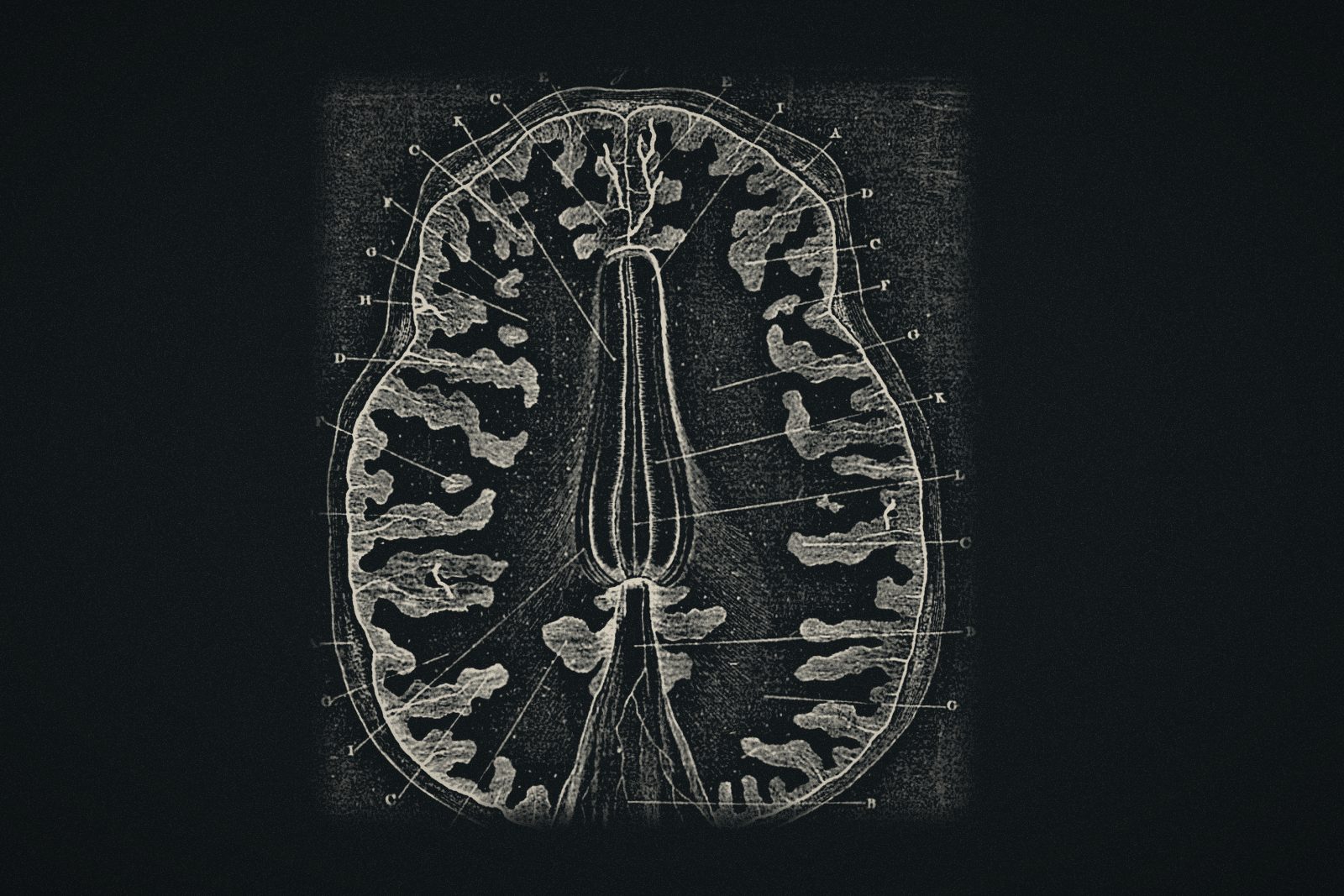
A modulatory layer. The models have recruitment and inhibition, and nothing setting the regime those run in. Bees have candidates.
Whether these belong in the architecture as a separate axis — gain rather than content — is untested. The third cuts across the tidy version: if a targeted inhibitory signal moves a diffuse modulator, then selecting among candidates and setting the regime are not cleanly separable.
A write step. Queen pheromone has been examined against expression of genes responsible for epigenetic modifications in worker brains.
Placing that as the durable-change step is an analogy across levels. The level mismatch is real: the bee side is role-level — dancer, follower, scout — and the neural side is cell-type-level.
Two observations that cut the other way
The signal is shaped by its audience. Removing bees from the dance floor, and separately replacing adults with bees too young to follow, was used to test whether dance information content depends on who is watching. Directional and distance precision tracked follower numbers; mean waggle-run duration and distance per run are reported unchanged.
A variance effect, not a bias effect. A population whose output precision depends on its readership is not a one-way sender.
No offline replay on the bee side. The dance is a waggle run, then a return loop alternating left and right. The loop repositions; no reversed waggle run is reported. Compressed reactivation of place-cell sequences in both directions is a large neural literature. The bee-side absence is absence of reported evidence, not a study that looked.
What would make this wrong
- Follower recruitment determined almost entirely by instantaneous dance properties, with no contribution from prior dance-floor state.
- Simultaneous dances that do not measurably interact through competition for a finite pool.
- Cross-inhibition in swarms and cortex producing qualitatively different dynamics under matched conditions.
- Thresholds turning out to be observer cutoffs rather than nonlinear population transitions.
One caution on the neural side. Reaching for cortical disinhibition as the mechanism of attention and then borrowing it imports an unsettled claim.
On sources
Two of the papers above were read beyond their abstracts: the 2009 framework, in the sections carrying its conclusions, and the audience study, its results section. The rest are entry points. Where this post says a study examined or tested something, that wording is load-bearing — it marks pointing at a result rather than having checked it.
Version history 2 revisions
Generated from this site's git history. with Claude means the commit carries a co-author line for an Anthropic model: an LLM took part in that change, not necessarily in every word of it, and git cannot say which. The same history on GitHub →
-
v2 2026-09-12 07:54 posts: inline source cards, and every post cut to the point
description: >-Two systems — aA honeybee colony choosing a nest and a cortical population choosing betweenchoosing betweentwo motions—havebeen givencarried the same formal description since 2009. What itsince at least 2009. What that descriptioncovers, and where its own authors say it stops.date: 2026-09-12 07:00:00 -0600tier: Cinline_sources: trueclaims:- barron2007- linn2020- dong2023- linn2020- cardosojunior2020- myersjoseph2024citation_notes:- marshall2009b >> The formal treatment. Read at full text for the sections carrying its conclusions; the model derivations were not read.- marshall2009 >> Same authors, same year, the idea under a different heading.- seeley2012 >> The experimental result usually paired with the framework above.- reina2017 >> Extends the analysis past two options.- lin2026 >> Results section read in full. The statistics quoted here come from it; no interpretation is attributed to it.- myersjoseph2024 >> Published version of a preprint; the published title narrows the claim to cross-modal attention.image: /assets/posts/waggle-dance.jpgsummary: >-A swarm deciding where to nest and a cortical population deciding which waydots are moving have been modelled with the same equations for over fifteenyears, and the idea is older than that. This is an inventory of what thecorrespondence actually covers, which parts of it are the authors' own claimrather than an inference, and the two places the papers themselves say itstops.Inventory of an existing parallel, not a proposal. A swarm choosing a nest anda cortical population choosing a direction are modelled as the samestatistical procedure. The parallel is not mine; it dates to at least 1979 andwas formalised in 2009.---This is an inventory, not an argument. The parallel described below is not mine and is not new; the point of writing it down is to be precise about how much of it is established, and where the edges are.An inventory. The parallel below is not mine and is not new.## Theobservationparallel, and whose it isA honeybee swarm choosing between two candidate nest sites and a cortical population choosing which way a field of dots is moving have been given the same formal description. The clearest statement of it is a 2009 paper in *Journal of the Royal Society Interface* {% include cite.html key="marshall2009b" %}, which sets a model of primate cortical decision-making beside three models of house-hunting in ants and honeybees and works through what they share.Its own opening is careful to say the idea was already old: speculation about whether decision-making in brains and in insect colonies is related, in the authors' words, begins "at least with Hofstadter (1979)" and had been taken up repeatedly before they wrote. They describe their contribution as a first step toward a common theoretical framework — one based on the interactions between a system's components rather than on what the components are. A companion piece the same year discusses the same territory under the heading of colony-level cognition {% include cite.html key="marshall2009" %}.A swarm choosing between two nest sites and a cortical population choosing which way dots move have been given one formal description.{% include source.html key="marshall2009b" %}That paper dates the idea to "at least Hofstadter (1979)" in its own introduction, and describes itself as a first step toward a common framework — one built on how a system's components interact rather than on what they are.{% include source.html key="marshall2009" %}So the lineage runs roughly: an analogy in the 1970s, recurring discussion, a formal treatment in 2009, and then theThe experimental workmostusuallyoftenpairedcited alongsidewith it,onconcerns inhibitory signalling between scouts.{% include cite.html key="seeley2012" %} — a paper whose ownIts title and framing put the comparison to brains in frontand centre, rather than leaving it to a reader.{% include source.html key="seeley2012" %}## What thecorrespondence actuallydescription coversThreethingsproperties,as set out inper the 2009 treatment:- **Populations, not individuals.**Both systems are modelled as mutually interactingInteracting populationsthataccumulate noisy evidence for competing alternatives.- **A threshold on one population.**AThechoicealternativeis made when onewhose population's activitycrossesa threshold, and the alternative that population representsfirst is the one taken.- **A threshold that can be moved.** The same threshold trades speed against accuracy. Raise it and decisions get slower and more reliable; lower it and the reverse. In the cortical model this is a parameter; in the ants it is the number of individuals that must accumulate at a site.- **A threshold that moves.** Raising it buys accuracy and costs speed. A parameter in the cortical model; a headcount at a site in the ants.Theformalclaimattached to thisis stronger thanaresemblance. Under particular settings,the cortical model reduces to a diffusion processthat implementsimplementing the sequential probability ratio test —the procedure that,for a two-way choice,minimisesthe procedure minimising decision timeforat any given error rate. The2009analysis asks whichof thecolony modelscando the samething, and treats the answer as asource of testable predictionsprediction about how coloniesought toshould behave ifthey aredeciding optimally.That is the substance of the parallel: not that a hive resembles a brain, but that both can be written as the same statistical procedure.Extending the same analysis past two options changes it. The best-of-N case — more than two options — has been analysed separately for whether the controlling parameter stays the same {% include cite.html key="reina2017" %} — which is also the point where this literature meets the best-of-N problem in distributed and robotic systems, since that is the same problem stated without the bees.Past two options the analysis changes.{% include source.html key="reina2017" %}This is also where the literature meets the best-of-N problem in distributed and robotic systems — the same problem stated without the bees.## Wheretheitspapersown authors say it stopsTwo limits come from the 2009 treatment itself, not from a critic.**The colonyhas tomust go and get itsinformationevidence.** In the cortical task, evidence for both alternatives arrives at a fixed,equal rate.A colony's scoutsScouts discover sites stochastically,which leaves the colony holdingleaving an explore-or-exploit problem the cortical version does not have: assessthewhatsites alreadyis known, or look for betterones. The authorsdescribecallthis asit a hybrid of a bandit problem and a minimum-decision-time problem, and sayno onenobody had formalised it.**Consensusandis not foragingare different problems.**This one is easy to lose.The paper statesplainlythatthe decision acolonysolves while emigratingemigration is *optimal consensus* decision-making,andthat this"differs from the problem of distributed resource intake maximization that colonies tackle during foraging."The quorumQuorum figures,and the cross-inhibition result,come from nest-site selection during swarming. Foraging recruitmentisrunsgoverned byon different machinery. A description that movesfreelybetween the two is describing two systems, not one.## Twodirections the mapping is being pushedextensions, neither establishedThe following are working framings, recorded here as untested rather than as findings.**A modulatory layer.** The decision models above have recruitment and inhibition in them, and nothing that sets the regime those operate in. Bees have candidates for such a layer: octopamine dosing has been examined for its effect on how strongly value is reported in dances {% include cite.html key="barron2007" %}, octopamine and dopamine have been examined in dance following and information use {% include cite.html key="linn2020" %}, and an inhibitory signal associated with danger has been examined against dopamine levels {% include cite.html key="dong2023" %}. Whether these belong in the decision architecture as a separate axis — gain rather than content — is a framing, not a result. Note also that the last of those cuts across the tidy version of it: if a targeted inhibitory signal moves a diffuse modulator, then "selecting among candidates" and "setting the regime" are not cleanly separable.Recorded as framings, not findings.**A modulatory layer.** The models have recruitment and inhibition, and nothing setting the regime those run in. Bees have candidates.{% include source.html key="barron2007" %} {% include source.html key="linn2020" %} {% include source.html key="dong2023" %}Whether these belong in the architecture as a separate axis — gain rather than content — is untested. The third cuts across the tidy version: if a targeted inhibitory signal moves a diffuse modulator, then selecting among candidates and setting the regime are not cleanly separable.**A write step.** Queen pheromone has been examined against expression of genes responsible for epigenetic modifications in worker brains.{% include source.html key="cardosojunior2020" %}**A write step.** Queen mandibular pheromone has been examined against the expression of genes responsible for epigenetic modifications in worker brains {% include cite.html key="cardosojunior2020" %}.Placing that as the durable-change stepof a decision architectureis an analogy across levels,.and theThe level mismatch is real: the bee sideof most of these mappingsis role-level — dancer, follower, scout —whileand the neural side is cell-type-level.## Two observations that cut the other way**The signal is shaped by its audience.** Recent work tested whether the information content of the dance depends on who is watching, by removing bees from the dance floor and separately by replacing adults with bees too young to follow {% include cite.html key="lin2026" %}. Directional and distance precision tracked the number of followers; the precision measures moved, and the paper reports the mean waggle run duration and distance per run as unchanged. Anything built on this should preserve that shape: it is a variance effect, not a bias effect. A population whose output precision depends on the size of its readership is not a one-way sender.**The signal is shaped by its audience.** Removing bees from the dance floor, and separately replacing adults with bees too young to follow, was used to test whether dance information content depends on who is watching. Directional and distance precision tracked follower numbers; mean waggle-run duration and distance per run are reported unchanged.{% include source.html key="lin2026" %}A variance effect, not a bias effect. A population whose output precision depends on its readership is not a one-way sender.**There is noNo offline replay on the bee side.** The dancehas a fixed structure —is a waggle run, then a return loopthat alternatesalternating left and right. Thereturnloop repositionsthe dancer; no reversed waggle run is reported.On the neural side, compressedCompressed reactivation of place-cell sequences in both directions is a large neural literature. The bee-side absenceof a bee counterpartisanabsence of reported evidence,rather thannot a study that lookedand found none, and it is the clearest gap in the correspondence as it currently stands.{% include source.html key="dong2023b" %}## What would make thisdescriptionwrongThe parallel is about dynamics, so the things that would break it are dynamical:- Follower recruitmentturning out to bedetermined almost entirely bytheinstantaneous dance propertiesof a dance, with no contribution fromtheprior dance-floor stateof the dance floor.- Simultaneous dances that do not measurably interact through competition for a finite pool.- Cross-inhibition in swarms andincortex producing qualitatively different dynamics under matched conditions.-The thresholdsThresholds turning out to be observer cutoffs rather than nonlineartransitions in apopulationvariabletransitions.One more caution belongs here, because it is about the neural side rather than the bee side. It is tempting to reach for cortical disinhibition as the mechanism of attention and then borrow it. Whether that link holds is an open question in its own literature, and has been tested directly for one interneuron class in primary visual cortex {% include cite.html key="myersjoseph2024" %}. Importing "disinhibition is attention" would import an unsettled claim, whichever way it settles.One caution on the neural side. Reaching for cortical disinhibition as the mechanism of attention and then borrowing it imports an unsettled claim.{% include source.html key="myersjoseph2024" %}## On sourcesTwo of the paperscitedabovehere have beenwere read beyond their abstracts: the 2009 frameworkpaper, in the sections carrying its conclusionsrather than its derivations, and the audience study,whoseits results sectionwas read in full. The rest arecited asentry pointsto their topics. Where this postdescribes whatsays a study *examined* or *tested* something, that wording isdeliberateload-bearing — it marksthe difference betweenpointing at a resultandrather than having checked it.Social learning of the dance itself {% include cite.html key="dong2023b" %} is cited on the same footing. -
v1 2026-09-12 07:08 post: a hive and a cortex, described the same way
v1: the original version, as first committed. Read it on GitHub →