August 31, 2026 · Bioelectromagnetic propagation · v6
What already reads the field
Sharks, bumblebees, spiders, electric fish, sediment bacteria and migratory birds all solve sensing problems this bench keeps re-deriving. A survey of the biological precedent — and one popular story about spider webs that is wrong.
- [C]
- 12 resolved sources
.jpg)
In short
Biology solved electric and magnetic sensing long before anyone built an instrument for it, and the solutions are stranger than the engineering ones. Two of the three field-sensing organisms here do it with hair rather than electrodes; one system does it with no receptor at all; and the two magnetic mechanisms are so different that copying one gives you a compass and copying the other gives you a spectrometer.
Survey of biological precedent. Phenomena are described at the level where they are settled. Six of the twelve sources below were read at full text and are marked as such on their cards. The other six could not be — paywalled or unindexed — and are entry points only: where this post says a study examined something, or hedges a mechanism, that marks pointing at a result rather than having checked it. The two flat statements that rest on an unread source are textbook-level and carry nothing specific to those papers.
Reading a field another body makes
Sharks, rays and skates detect the standing bioelectric field around another animal, using jelly-filled canals in the head called the ampullae of Lorenzini. Seawater conducts, so the field stays readable at a distance.
Bumblebees detect the electric field around a flower, learn it as a reward cue, and discriminate one field geometry from another. A flying bee carries about 32 pC, positive in 94% of individuals measured; a flower sits near ground potential through its stem and roots. The difference is the signal.
The sensor is body hair, not the antenna. Charged hairs move measurably at a stimulus around twenty times weaker than antennae need, and hair deflection produces nerve firing where antennal deflection produces none — with air-puff and scent controls confirming the antennal recording was live.
Spiders detect the atmospheric potential gradient — the standing voltage between ground and sky — and use it as a cue for ballooning.
Both air cases use hair, not electrodes. A charged filament in a field experiences a force and moves; both animals already had an organ good at detecting hair movement, because that is how they sense air currents and vibration. The field sense is a mechanical sense in a different role.
For instrument design that reframes the problem: a field detector need not be a voltage-measuring device in contact with anything. Anything charged, compliant, and watched closely enough is a candidate.
Geometry with no sensor in it
Insects in flight carry charge. Held near a grounded orb web, charged honeybees, bottle flies, fruit flies, aphids and water drops pull silk threads toward them by 1–2 mm at 0.7–1.9 m/s; uncharged controls produce no such deformation. Cross-spider mesh spacing is about 2 mm, so the measured deflection is the size of the gap it would have to close. Roughly 30% of charged-insect trials produced no visible deformation and were kept in the analysis anyway, which is where the large variance comes from.
Capture probability was not measured. The deformation was. The effect on prey capture is an inference from the deflection being mesh-sized, and the paper says so in those terms. The charge a web carries in the wild has never been reported.
There is no receptor anywhere in this. No nerve, no organism doing anything. A passive dielectric structure whose shape converts a static charge difference into mechanical motion.
A correction worth recording: the effect is electrostatic, not optical. Not photon interaction, not amplification of light, not a quantum-optical property of the spiral. The optical version circulates widely and has nothing behind it.
Active electric sense
Some fish generate a field and read its distortion, rather than reading a field something else made. That inverts the problem: the organism supplies the carrier — and then has to subtract it. A mormyrid’s own discharge reaches its passive electroreceptors too, and the electrosensory lobe cancels it with a negative image assembled from granule-cell responses that span the roughly 200 ms following the motor command.
The timing-dependent plasticity rule such a prediction would be learned through is an entry point here, not something checked.
Self-interference is part of the design, not a defect in it. Any instrument that supplies its own carrier inherits the same problem, and the biological answer is a learned model of its own output rather than a better filter.
Signals that travel
Distance kills most sensing ideas, so what biology manages is worth knowing.
Filamentous bacteria in marine sediment have been examined for electron transport along their length, over distances described in centimetres — modest until held against the size of a cell.
Plants have been examined for a different long-range mechanism: whether a wound at one site triggers a travelling calcium signal reaching undamaged tissue elsewhere.
These would not be the same transport. Most of what this bench reasons about is ionic — charge across a membrane. The cable-bacteria claim is electron transport, a different mechanism, and it is a claim this bench has pointed at rather than checked. “Biological conduction” is not one thing.
On algae: giant algal cells are foundational in plant electrophysiology and carry propagating electrical signals. No source for long-distance algal signalling is in the ledger yet, so there is no entry. A gap, not a judgement.

A tuned mechanical receiver
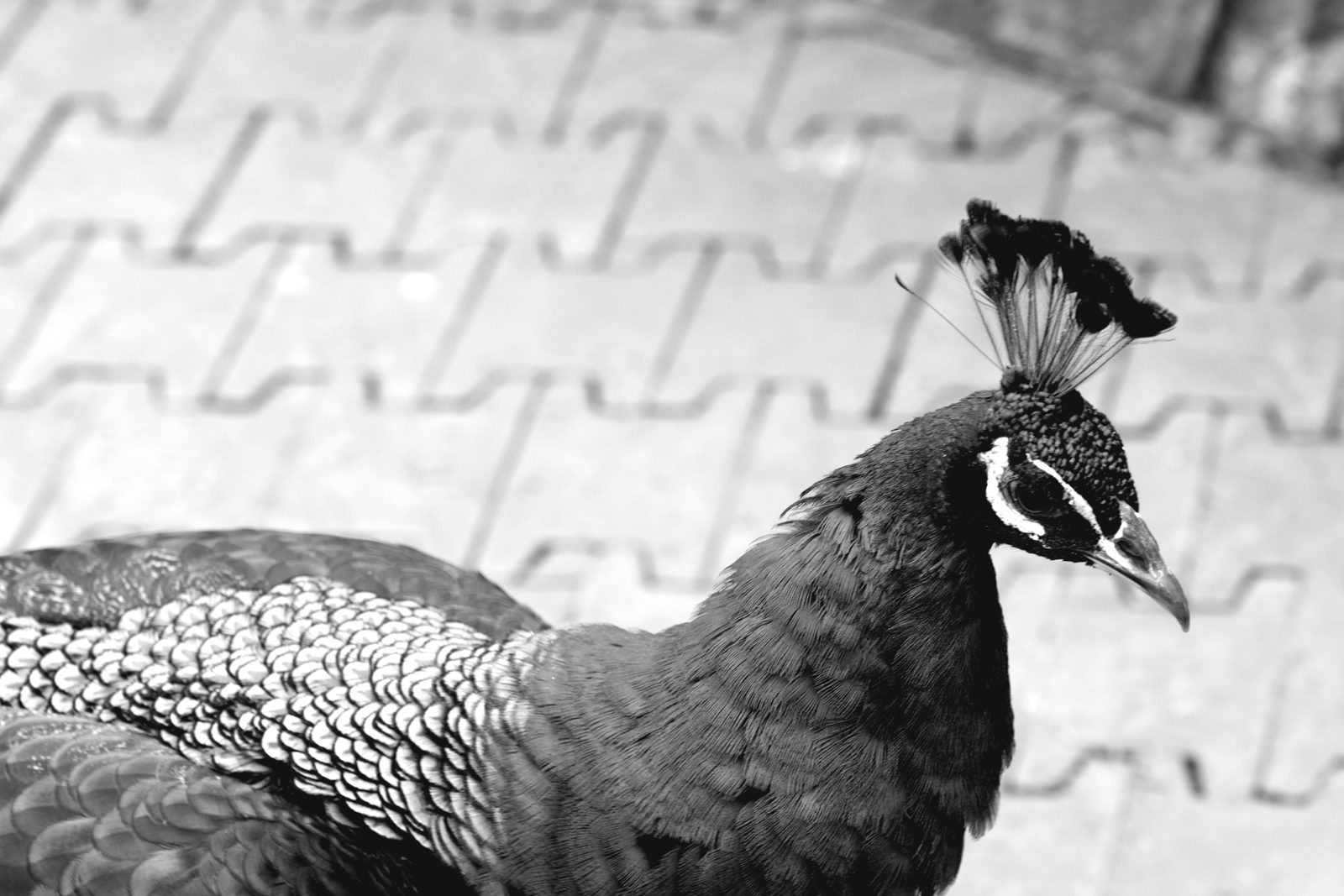
Peafowl crest feathers have been measured for resonance against the frequencies of conspecific display.
The relevant quantity is the gain a tuned passive resonator buys, and the reported values are single-digit. Useful as a ceiling: a passive biological resonator in fluid at body temperature is not a high-Q device.
Two ways to feel the Earth
Some bacteria swim along the local geomagnetic field and carry iron-rich particles inside intracytoplasmic vesicles. That those particles give the cell a magnetic moment which torques it into alignment is how the original report proposed it — the word that report used was “conceivably” — and it is settled textbook material today. It was not checked here.
A compass needle, on the accepted mechanism. No energy budget, no light, no computation, no nervous system. The physics does the work.
Migratory songbirds are thought to do something else — a light-dependent reaction in a retinal protein, where the field influences the chemistry of a short-lived radical pair.
A chemical magnetometer, if the mechanism holds. It would need a photon to start, and would report the field as a change in reaction yield rather than as a force.
Copy the first and you have built a magnetometer. Copy the second and you have built a spectrometer that happens to be field-sensitive. Same environmental quantity, two instruments with nothing in common.
What transfers
- A field sensor can be a motion sensor. Two of the three organisms above read electric fields with hairs.
- Geometry alone can convert a field into motion, with no receptor in the loop.
- Long-distance conduction may not always be ionic. Electron transport is claimed too.
- Passive resonance buys single-digit gain. Not orders of magnitude.
None of this is evidence for anything claimed here. It is a map of where the good ideas already are, and every one was arrived at by something with no access to an amplifier.
Correction — 2026-09-12
The original text said the spiderweb study tested “whether it changes capture probability.” It did not. That study measured thread deformation only; the effect on prey capture is the authors’ inference from the deformation being the size of the web’s mesh spacing, and they state it as such. The paragraph has been rewritten and the inference is now marked as one.
Two further statements were written flatter than their sources supported and have been hedged: the torque mechanism in magnetotactic bacteria, which the 1975 report offers as conjecture, and the radical-pair mechanism in songbirds, which remains a proposal.
This post published on 2026-08-31 with two of its twelve sources read at full text. Ten were chased on 2026-09-12; four more could be read and are now marked on their cards, and the bumblebee and mormyrid paragraphs were rewritten to report what those papers actually found. The remaining six are paywalled or unindexed, and every statement resting on one of them is pointing language by design, not by accident.
The post’s tier has been lowered from B to C in the same change. Tier B requires that the gate pass in strict mode, which fails on any source not read at full text; six of these cannot be read at any price short of buying them individually. C is the tier whose rule this post actually satisfies — unread sources are permitted, provided the prose that rests on them is hedged, which is now the case for all six. Nothing in the findings above got weaker; the label got honest.
Corrections
If a statement above overreaches its source, that is a defect and worth reporting — the point of citing by key is that you can check. The spider-web paragraph exists because the wrong version was believed here first.
Version history 6 revisions
Generated from this site's git history. with Claude means the commit carries a co-author line for an Anthropic model: an LLM took part in that change, not necessarily in every word of it, and git cannot say which. The same history on GitHub →
-
v6 2026-09-12 08:23 Post: correct the spiderweb claim, and drop the tier to C
inline_sources: truetier:BCclaims:- morley2018- ortegajimenez2013- kennedy2014- bell1997- kennedy2014- ortegajimenez2013- pfeffer2012---Survey of biological precedent. Phenomena are described at the level where they are settled.TwoSix of the twelve sources below were read at full text and are marked as such on their cards;.theTherestother six could not be — paywalled or unindexed — and are entry points,andonly: where this post says a study *tested* or *examined* something, or hedges a mechanism, that marks pointing at a result rather than having checked it. The two flat statements that rest on an unread source are textbook-level and carry nothing specific to those papers.## Reading a field another body makes{% include source.html key="kalmijn1971" %}Bumblebees detect the electric field around a flower.Bumblebees detect the electric field around a flower, learn it as a reward cue, and discriminate one field geometry from another. A flying bee carries about 32 pC, positive in 94% of individuals measured; a flower sits near ground potential through its stem and roots. The difference is the signal.{% include source.html key="clarke2013" %}{% include source.html key="sutton2016" %}The sensor is body hair, not the antenna. Charged hairs move measurably at a stimulus around twenty times weaker than antennae need, and hair deflection produces nerve firing where antennal deflection produces none — with air-puff and scent controls confirming the antennal recording was live.{% include source.html key="sutton2016" %}Spiders detect the atmospheric potential gradient — the standing voltage between ground and sky — and use it as a cue for ballooning.## Geometry with no sensor in itInsects in flight carry charge; a web does not. Whether that difference deforms the silk toward a passing insect, and whether it changes capture probability, has been tested directly.Insects in flight carry charge. Held near a grounded orb web, charged honeybees, bottle flies, fruit flies, aphids and water drops pull silk threads toward them by 1–2 mm at0.7–1.9 m/s; uncharged controls produce no such deformation. Cross-spider mesh spacing is about 2 mm, so the measured deflection is the size of the gap it would have to close. Roughly 30% of charged-insect trials produced no visible deformation and were kept in the analysis anyway, which is where the large variance comes from.{% include source.html key="ortegajimenez2013" %}**Capture probability was not measured.** The deformation was. The effect on prey capture is an inference from the deflection being mesh-sized, and the paper says so in those terms. The charge a web carries in the wild has never been reported.**There is no receptor anywhere in this.** No nerve, no organism doing anything. A passive dielectric structure whose shape converts a static charge difference into mechanical motion.## Active electric senseSome fish generate a field and read its distortion, rather than reading a field something else made. That inverts the problem: the organism supplies the carrier — and then has to subtract it. A mormyrid's own discharge reaches its passive electroreceptors too, and the electrosensory lobe cancels it with a negative image assembled from granule-cell responses that span the roughly 200 ms following the motor command.{% include source.html key="bell1997" %}{% include source.html key="kennedy2014" %}The timing-dependent plasticity rule such a prediction would be learned through is an entry point here, not something checked.{% include source.html key="bell1997" %}**Self-interference is part of the design, not a defect in it.** Any instrument that supplies its own carrier inherits the same problem, and the biological answer is a learned model of its own output rather than a better filter.## Signals that travel{% include source.html key="toyota2018" %}**Thesearewould not be the same transport.** Most of what this bench reasons about is ionic — charge across a membrane.CableThe cable-bacteriamoveclaimelectronsis electron transport, a different mechanism, and it is a claim this bench has pointed at rather than checked. "Biological conduction" is not one thing.*On algae: giant algal cells are foundational in plant electrophysiology and carry propagating electrical signals. No source for long-distance algal signalling is in the ledger yet, so there is no entry. A gap, not a judgement.*## Two ways to feel the EarthSome bacteria build chains of magnetic particles in membrane-bound compartments. The cell is physically torqued into alignment.Some bacteria swim along the local geomagnetic field and carry iron-rich particles inside intracytoplasmic vesicles. That those particles give the cell a magnetic moment which torques it into alignment is how the original report proposed it — the word that report used was "conceivably" — and it is settled textbook material today. It was not checked here.{% include source.html key="blakemore1975" %}**A compass needle,literallyon the accepted mechanism.** No energy budget, no light, no computation, no nervous system. The physics does the work.Migratory songbirds are thought to do something else — a light-dependent reaction in a retinal protein, where the field influences the chemistry of a short-lived radical pair.{% include source.html key="xu2021" %}**A chemical magnetometer, if the mechanism holds.**NeedsIt would need a photon to start, andreportswould report the field as a change in reaction yield rather than as a force.Copy the first and you have built a magnetometer. Copy the second and you have built a spectrometer that happens to be field-sensitive. Same environmental quantity, two instruments with nothing in common.2. **Geometry alone can convert a field into motion**, with no receptor in the loop.3. **Long-distance conductionismay not always be ionic.**ElectronsElectrontraveltransport is claimed too.4. **Passive resonance buys single-digit gain.** Not orders of magnitude.None of this is evidence for anything claimed here. It is a map of where the good ideas already are, and every one was arrived at by something with no access to an amplifier.## Correction — 2026-09-12The original text said the spiderweb study tested "whether it changes capture probability." It did not. That study measured thread deformation only; the effect on prey capture is the authors' inference from the deformation being the size of the web's mesh spacing, and they state it as such. The paragraph has been rewritten and the inference is now marked as one.Two further statements were written flatter than their sources supported and have been hedged: the torque mechanism in magnetotactic bacteria, which the 1975 report offers as conjecture, and the radical-pair mechanism in songbirds, which remains a proposal.This post published on 2026-08-31 with two of its twelve sources read at full text. Ten were chased on 2026-09-12; four more could be read and are now marked on their cards, and the bumblebee and mormyrid paragraphs were rewritten to report what those papers actually found. The remaining six are paywalled or unindexed, and every statement resting on one of them is pointing language by design, not by accident.The post's tier has been lowered from B to C in the same change. Tier B requires that the gate pass in strict mode, which fails on any source not read at full text; six of these cannot be read at any price short of buying them individually. C is the tier whose rule this post actually satisfies — unread sources are permitted, provided the prose that rests on them is hedged, which is now the case for all six. Nothing in the findings above got weaker; the label got honest.## Corrections -
v5 2026-09-12 07:54 posts: inline source cards, and every post cut to the point
status: publishedinline_sources: truetier: B---Three times now I have hit a sensing question on this bench — how weak a field can be detected, across what distance, with what geometry — and found that something alive had already settled it. This post is the survey I wish I had read first.**What this post is, exactly.** Most of it describes phenomena at the level where they are settled and uncontroversial, and most of the sources below are cited as *the entry point to their topic* — not read here at full text, so nothing on this page reports what those papers measured or concluded. Where I say something is known, I mean textbook-known, not "this study showed."**One source is different.** The peafowl work has been read at full text, so that section does report what it found, and the post is tiered `B` on account of it rather than `A`. The reference list marks which is which; a badge on an entry reading *full text read* is the difference between "this paper exists" and "this paper found."Survey of biological precedent. Phenomena are described at the level where they are settled. Two sources below were read at full text and are marked as such on their cards; the rest are entry points, and where this post says a study *tested* or *examined* something, that marks pointing at a result rather than having checked it.## Reading a field another body makesThe oldest example is the one everybody has heard of.Sharks, rays and skates detect the standing bioelectric fieldthat surroundsaround another animal, using jelly-filled canals in the head called the ampullae of Lorenzini{% include cite.html key="kalmijn1971" %}. Seawaterhelps enormously here: itconducts, soa body'sthe fieldpropagates through it andstays readable at a distance.The two examples that impressed me more happen in **air**, which is much harder, because air does not conduct and there is no comparable field to swim through.{% include source.html key="kalmijn1971" %}Bumblebees detect the electric field around a flower.{% include source.html key="clarke2013" %} {% include source.html key="sutton2016" %}Bumblebees detect the electric field around a flower {% include cite.html key="clarke2013" %}.Spiders detect the atmospheric potential gradient — the standing voltagedifferencebetweentheground andthesky — and use it as a cue for ballooning{% include cite.html key="morley2018" %}.Both solve the air problem the same way, and this is the part worth taking:{% include source.html key="morley2018" %}**neitherBothusesairanything like an electrode.** Theycases use hair,{%notinclude citeelectrodes.html key="sutton2016" %}.** A charged filamentsittinginan electrica field experiences a force and moves, and; both animals already had an organexquisitelygood at detectingthehair movementof hairs, because that is how they sense air currents and vibration. The field sense is a*mechanical*sensewearingin a differenthatrole.Foranyoneinstrumentbuilding an instrument,design that reframes the problem.:Aa field detectordoesneed nothave tobe a voltage-measuring device in contact withsomethinganything.It can be anythingAnything charged, compliant, and watched closely enough is a candidate.##ReadingGeometryawithfieldnoyousensormakeinyourselfitEverything above is passive: the animal reads a field something else produced. There is a second mode, and it is the one an instrument builder should look at hardest, because it is the one where you supply the signal.Weakly electric fish emit a discharge from a dedicated organ and read how nearby objects perturb it. That is active sensing — the same idea as radar or sonar, arrived at independently, in water.What makes it worth studying is not that it works. It is what it costs. Four things have to be present, and each is separately necessary:1. An organ that produces a discrete, command-triggered discharge.2. A receptor class tuned to that discharge, distinct from the receptors the same fish uses to sense other animals passively.3. A cerebellum-like structure that learns a **negative image** of the animal's own discharge and subtracts it, through a plasticity rule that depends on the order in which the two inputs arrive {% include cite.html key="bell1997" %}.4. A **corollary discharge** — a copy of the motor command that fired the organ — supplying the timing the negative image is built against {% include cite.html key="kennedy2014" %}.Item 4 is the one I keep coming back to. The cancellation is not computed from the recorded signal. It is timed from the *command that caused it*, before the signal arrives. An instrument that emits and then tries to subtract its own contribution by measuring it is solving a harder problem than the fish is, and the fish has had a long time to look for an easier route.The other half of the lesson is a warning about copying it. This works in water because water conducts, so the fish drives a current through the medium and objects perturb the current density at its skin. Air does not conduct. The nearest thing in air is capacitive — a nearby object changes how much charge sits where — which is a different quantity, with a different distance dependence, and it responds to a different property of the object. The intuition transfers; the arithmetic does not.## The spider web — and the story that is wrongThere is a well-travelled claim that a spider web's geometry does something clever with *light* — that the web amplifies a fly's photons, or exploits some optical property of the spiral. I went looking for it because it is a good story.It is not what happens. What actually happens is**electrostatic** {% include cite.html key="ortegajimenez2013" %}. Insects in flight carry charge. A web does not. When a charged insect passes close, the silk is pulled toward it — the threads physically deform in its direction, which makes contact more likely than the geometry alone would predict.That is a better story than the optical one, for a reason worth stating plainly:Insects in flight carry charge; a web does not. Whether that difference deforms the silk toward a passing insect, and whether it changes capture probability, has been tested directly.{% include source.html key="ortegajimenez2013" %}**thereThere is nosensorreceptor anywhere initthis.** Noreceptor, nonerve, no organism doing anything.It is aA passive dielectric structure whose shape converts a static charge difference into mechanical motion.Everything else in this post is an animal reading a field. This is geometry alone doing the work.I mention the correction rather than quietly writing the right version because the two ideas get conflated constantly, and only one of them has a source behind it.A correction worth recording: the effect is **electrostatic, not optical.** Not photon interaction, not amplification of light, not a quantum-optical property of the spiral. The optical version circulates widely and has nothing behind it.## Active electric senseSome fish generate a field and read its distortion, rather than reading a field something else made. That inverts the problem: the organism supplies the carrier.{% include source.html key="bell1997" %} {% include source.html key="kennedy2014" %}## Signals that travelDistanceis the constraint thatkills most sensing ideas, soitwhat biology manages is worth knowingwhat biology manages.InFilamentous bacteria in marine sedimenttherehavearebeenfilamentousexaminedbacteriaforthatelectronmove **electrons**transport along their length,through conductive structures running the length of the filament {% include cite.html key="pfeffer2012" %}. Theover distancesinvolveddescribedarein centimetres —which soundsmodest untilyou hold itheld against the size of a cell, where it is enormous.{% include source.html key="pfeffer2012" %}Plantsdohavesomethingbeen examined for a differentand just aslong-rangedrange mechanism: whether a wound at one siteproducestriggers a travelling calciumwavesignalthat reachesreaching undamaged tissue elsewherein the organism {% include cite.html key="toyota2018" %}.{% include source.html key="toyota2018" %}The reason to keep these two apart is that they**These are not the samekind oftransport.** Most of whatI reason about onthis bench reasons about is ionic —the action potential,chargemovingacross a membrane.**Cable bacteriaare not doing that.** They are movingmove electrons, which is a different mechanism with different limits, and it is a useful reminder that. "biologicalBiological conduction" is not one thing.*(On algaespecifically: giant algal cells areafoundationalpreparationin plant electrophysiology anddocarry propagating electrical signals.I have not put aNo source for long-distance algal signallingintois in the ledger yet, so there is no entryfor it here.That is aA gap, not a judgement.)*##TheAothertunedhalf of amechanical receiverEverything above is about a *transducer* — the thing that turns a field into a signal. The peafowl crest is about what sits **in front** of one, and it is the clearest published case I have found of a biological pre-filter whose contribution can be read off in numbers rather than assumed.A peacock's display rattles its train at around 26 Hz. A peahen's crest — a fan of twenty to thirty feathers, each a tapered shaft with a wide flag at the end — is a mechanical resonator, and its resonant frequency sits inside that band, with filoplumes and their mechanoreceptors at the feather bases {% include cite.html key="kane2018" %}.This is the one source on this page I have read at full text, so it is the one whose findings I will actually state. The crests were measured on a shaker: female crests resonate near 28 Hz, male near 26, with quality factors around 5 and 6.**The number that matters is that quality factor**, because at resonance it is roughly the amplitude gain. Being tuned bought a factor of about five. Not a thousand, not a hundred — five. And a *Q* of five is a broad filter: about a twenty per cent band, which is a wide target for a 26 Hz stimulus to land in.So the resonator is not rescuing a signal from below the noise. It cannot be: the impacts in question deflect the crest by around nine millimetres, which is visible on ordinary video and sits enormously far above what a mechanoreceptor needs. What the tuning buys is**rejection** — a narrow-ish window centred on the frequency conspecifics actually display at, which ignores wind and footfalls and broadband racket. The gain is almost incidental.That is the transferable lesson, and it cuts against the intuition that biology must be doing something extraordinary: **a passive biological resonator buys single digits.** There is a real ceiling here — wet keratin at body temperature does not make a high-*Q* cavity. Sharper biological filtering exists, in the cochlea, but it is *active*: it spends energy, and anything claiming that trick has to say where the power comes from and what noise it adds.**And the honest caveat, which the paper states itself:** every one of those measurements was made on dried crests mounted on balsa. No live bird, no nerve recording, no behavioural test. That the crest is mechanically tuned to the display frequency is measured. That peafowl actually *use* it that way is not, and the authors say so.Peafowl crest feathers have been measured for resonance against the frequencies of conspecific display.{% include source.html key="kane2018" %}The relevant quantity is the gain a tuned passive resonator buys, and the reported values are single-digit. Useful as a ceiling: a passive biological resonator in fluid at body temperature is not a high-Q device.## Two ways to feel the EarthMagnetoreception is where the divergence gets sharpest, because the two best-known mechanisms have almost nothing in common.Some bacteria build chains of magnetic particles inside membrane-bound compartments {% include cite.html key="blakemore1975" %}. The cell is then physically torqued into alignment by the Earth's field. This is a **compass needle** in the most literal sense: no energy budget, no light, no computation, no nervous system. The physics does the work and the organism goes along with it.Some bacteria build chains of magnetic particles in membrane-bound compartments. The cell is physically torqued into alignment.{% include source.html key="blakemore1975" %}**A compass needle, literally.** No energy budget, no light, no computation, no nervous system. The physics does the work.Migratory songbirds are thought to do somethingentirely differentelse — a light-dependent reaction in a retinal proteinin the eye, where themagneticfield influences the chemistry of a short-lived radical pairof radicals {% include cite.html key="xu2021" %}. This is a{% include source.html key="xu2021" %}**A chemical magnetometer.**.It needsNeeds a photon to start, anditreports the field as a change inhow areactionturns outyield.Copy the first and you have built a magnetometer. Copy the second and you have built a spectrometer that happens to be field-sensitive. Same environmental quantity, two instruments with nothing in common— which is a useful thing to have internalised before deciding what "detecting the field" is going to mean for a given design.## WhatI take from ittransfersThree things, all structural, none of them a finding of mine:1. **A field sensor can be a motion sensor.** Two of the three organisms above read electric fields with hairs.Any charged, compliant surface is a candidate transducer.1. **Tuning is worth single digits, and it buys rejection more than gain.** The one measured number on this page is a factor of about five. A front end narrows the band the noise arrives through; it does not lift a signal that is already under the floor.2. **Geometry alone can convert a field into motion**, with no receptor in the loopat all.3. **Long-distance conductionin biologyis not always ionic.** Electrons travel too.4. **If an instrument emits, cancelling its own signal is most of the work** — and the one animal that does this times the cancellation from the command, not from the recording.4. **Passive resonance buys single-digit gain.** Not orders of magnitude.None of this is evidence for anythingIclaimedam claiminghere. It is a map of where the good ideas already are, and every oneof themwas arrived at by something with no access to an amplifier.## CorrectionsIfanya statement above overreaches its source, that is a defect andIworthwant it reportedreporting — thewholepoint of citing by key is that you cango andcheck. The spider-web paragraph exists becauseI believedthe wrong versionmyselfwas believed here first. -
v4 2026-09-01 11:18 site: strip the homepage header, centre the footer, add post images
- xu2021image: /assets/posts/peacock-crest.jpgimage_alt: >-A peafowl in profile, its fan-shaped head crest of narrow feathers with wideflags at the tips clearly visible against a paved background.image_credit: Thomas Quineimage_license: CC BY 2.0image_license_url: https://creativecommons.org/licenses/by/2.0/image_source_url: https://commons.wikimedia.org/wiki/File:Peacock_crest_(24697301410).jpgsummary: >- -
v3 2026-09-01 10:09 post: add the peafowl crest case, and the first source actually read
status: publishedtier:ABclaims:- toyota2018- kane2018- blakemore1975Three times now I have hit a sensing question on this bench — how weak a field can be detected, across what distance, with what geometry — and found that something alive had already settled it. This post is the survey I wish I had read first.**What this post is, exactly.**ItMost of it describes phenomena at the level where they are settled and uncontroversial, anditmostisoftieredtheaccordingly. Each sourcesources belowisare cited as *the entry point toitstheir topic* —none of them has beennot read here at full text, so nothing on this page reports whatanythoseindividual paperpapers measured or concluded. Where I say something is known, I mean textbook-known, not "this study showed."**One source is different.** The peafowl work has been read at full text, so that section does report what it found, and the post is tiered `B` on account of it rather than `A`. The reference list marks which is which; a badge on an entry reading *full text read* is the difference between "this paper exists" and "this paper found."## Reading a field another body makes*(On algae specifically: giant algal cells are a foundational preparation in plant electrophysiology and do carry propagating electrical signals. I have not put a source for long-distance algal signalling into the ledger yet, so there is no entry for it here. That is a gap, not a judgement.)*## The other half of a receiverEverything above is about a *transducer* — the thing that turns a field into a signal. The peafowl crest is about what sits **in front** of one, and it is the clearest published case I have found of a biological pre-filter whose contribution can be read off in numbers rather than assumed.A peacock's display rattles its train at around 26 Hz. A peahen's crest — a fan of twenty to thirty feathers, each a tapered shaft with a wide flag at the end — is a mechanical resonator, and its resonant frequency sits inside that band, with filoplumes and their mechanoreceptors at the feather bases {% include cite.html key="kane2018" %}.This is the one source on this page I have read at full text, so it is the one whose findings I will actually state. The crests were measured on a shaker: female crests resonate near 28 Hz, male near 26, with quality factors around 5 and 6.**The number that matters is that quality factor**, because at resonance it is roughly the amplitude gain. Being tuned bought a factor of about five. Not a thousand, not a hundred — five. And a *Q* of five is a broad filter: about a twenty per cent band, which is a wide target for a 26 Hz stimulus to land in.So the resonator is not rescuing a signal from below the noise. It cannot be: the impacts in question deflect the crest by around nine millimetres, which is visible on ordinary video and sits enormously far above what a mechanoreceptor needs. What the tuning buys is**rejection** — a narrow-ish window centred on the frequency conspecifics actually display at, which ignores wind and footfalls and broadband racket. The gain is almost incidental.That is the transferable lesson, and it cuts against the intuition that biology must be doing something extraordinary: **a passive biological resonator buys single digits.** There is a real ceiling here — wet keratin at body temperature does not make a high-*Q* cavity. Sharper biological filtering exists, in the cochlea, but it is *active*: it spends energy, and anything claiming that trick has to say where the power comes from and what noise it adds.**And the honest caveat, which the paper states itself:** every one of those measurements was made on dried crests mounted on balsa. No live bird, no nerve recording, no behavioural test. That the crest is mechanically tuned to the display frequency is measured. That peafowl actually *use* it that way is not, and the authors say so.## Two ways to feel the Earth1. **A field sensor can be a motion sensor.** Two of the three organisms above read electric fields with hairs. Any charged, compliant surface is a candidate transducer.1. **Tuning is worth single digits, and it buys rejection more than gain.** The one measured number on this page is a factor of about five. A front end narrows the band the noise arrives through; it does not lift a signal that is already under the floor.2. **Geometry alone can convert a field into motion**, with no receptor in the loop at all. -
v2 2026-09-01 09:55 what-already-reads-the-field: add active electrolocation, fix the bumblebee cite
description: >-Sharks, bumblebees, spiders, electric fish, sediment bacteria and migratorybirds all solvebirds all solve sensing problems this bench keeps re-deriving. A survey of thebiologicalbiological precedent — and one popular story about spider webs that is wrong.date: 2026-08-31 09:00:00 -0600- clarke2013- sutton2016- morley2018- bell1997- kennedy2014- ortegajimenez2013Both solve the air problem the same way, and this is the part worth taking:**neither uses anything like an electrode.** They use hair {% include cite.html key="sutton2016" %}. A charged filament sitting in an electric field experiences a force and moves, and both animals already had an organ exquisitely good at detecting the movement of hairs, because that is how they sense air currents and vibration. The field sense is a *mechanical* sense wearing a different hat.For anyone building an instrument, that reframes the problem. A field detector does not have to be a voltage-measuring device in contact with something. It can be anything charged, compliant, and watched closely enough.## Reading a field you make yourselfEverything above is passive: the animal reads a field something else produced. There is a second mode, and it is the one an instrument builder should look at hardest, because it is the one where you supply the signal.Weakly electric fish emit a discharge from a dedicated organ and read how nearby objects perturb it. That is active sensing — the same idea as radar or sonar, arrived at independently, in water.What makes it worth studying is not that it works. It is what it costs. Four things have to be present, and each is separately necessary:1. An organ that produces a discrete, command-triggered discharge.2. A receptor class tuned to that discharge, distinct from the receptors the same fish uses to sense other animals passively.3. A cerebellum-like structure that learns a **negative image** of the animal's own discharge and subtracts it, through a plasticity rule that depends on the order in which the two inputs arrive {% include cite.html key="bell1997" %}.4. A **corollary discharge** — a copy of the motor command that fired the organ — supplying the timing the negative image is built against {% include cite.html key="kennedy2014" %}.Item 4 is the one I keep coming back to. The cancellation is not computed from the recorded signal. It is timed from the *command that caused it*, before the signal arrives. An instrument that emits and then tries to subtract its own contribution by measuring it is solving a harder problem than the fish is, and the fish has had a long time to look for an easier route.The other half of the lesson is a warning about copying it. This works in water because water conducts, so the fish drives a current through the medium and objects perturb the current density at its skin. Air does not conduct. The nearest thing in air is capacitive — a nearby object changes how much charge sits where — which is a different quantity, with a different distance dependence, and it responds to a different property of the object. The intuition transfers; the arithmetic does not.## The spider web — and the story that is wrong3. **Long-distance conduction in biology is not always ionic.** Electrons travel too.4. **If an instrument emits, cancelling its own signal is most of the work** — and the one animal that does this times the cancellation from the command, not from the recording.None of this is evidence for anything I am claiming. It is a map of where the good ideas already are, and every one of them was arrived at by something with no access to an amplifier. -
v1 2026-08-31 15:57 site: adopt the monorepo design system, add two posts, publish the AI disclosure
v1: the original version, as first committed. Read it on GitHub →