August 25, 2026 · Audio-evoked potentials · v9
Can a $70 board tell me I'm wrong?
A single-channel EEG rig characterised in numbers: in-band 40 Hz power across six captures, why broadband RMS is the wrong figure to specify a rig by, and a proposed test of analog bandwidth as a validation axis.
- [C]
- 5 resolved sources
- AEP-0005
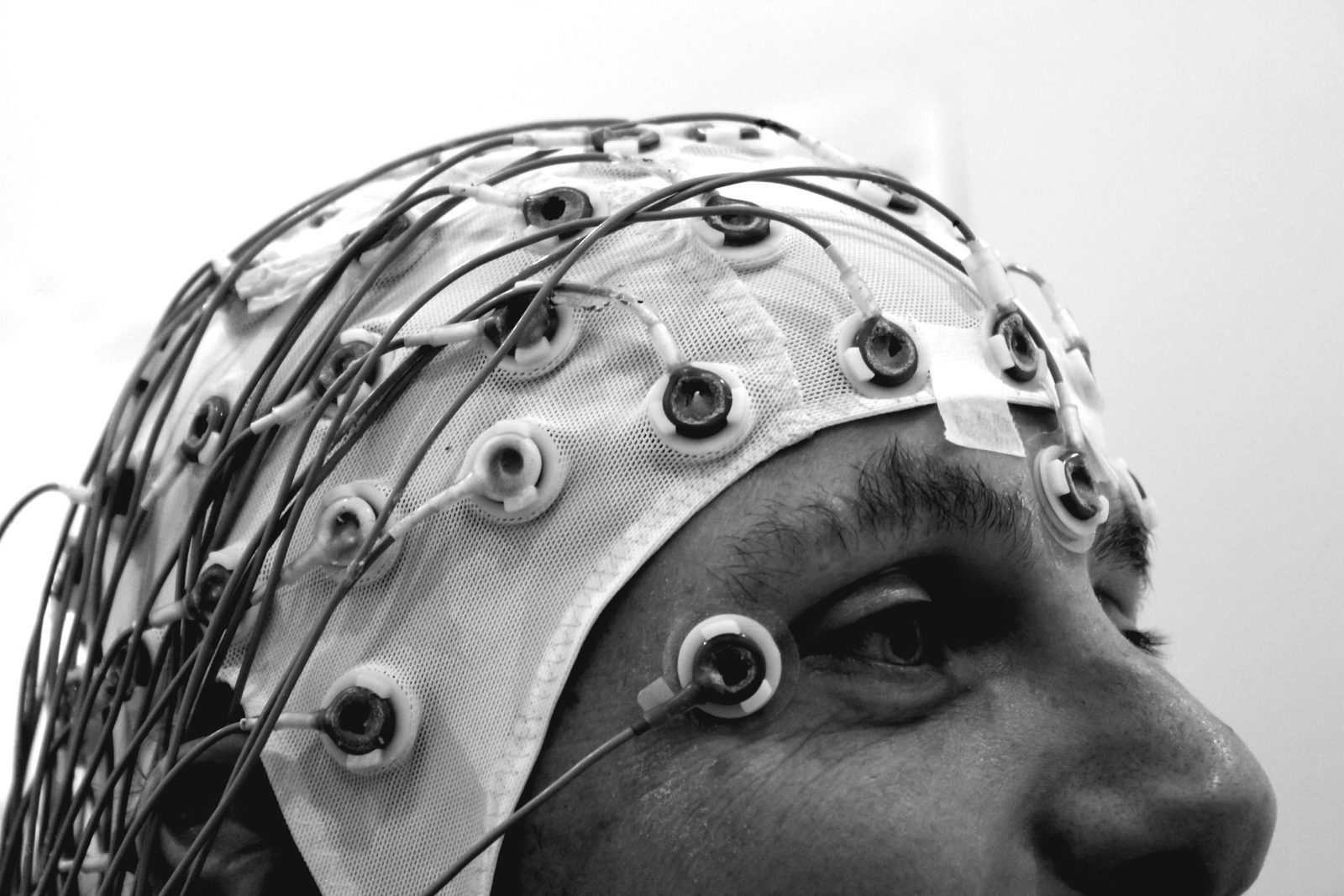

n-of-1 instrument characterisation. Written for people who validate low-cost EEG. One ask, after the rig sections. The auditory question that prompted the work is last.
In-band power at 40 Hz: median 157 nV, 11.7× spread
Six captures. One rig, one montage, one person. Amplitude at 40 Hz over 60 s of pre-stimulus baseline, estimated from neighbouring frequency bins.
| median | 157 nV |
| range | 64–750 nV (11.7×) |
| captures with ≥20 s usable baseline | 6 of 12 |
| baseline segments whose noise integrates with dwell | 5 of 9; the other 4 are drift-limited |
What this figure is not:
- Not instrument noise. No shorted-input capture exists. This is in-band power of a scalp recording, EEG and scalp EMG included.
- Not explained by electrode prep. The one capture the app scored good-contact (alpha SNR 36) has the highest value, 750 nV. The one it flagged no-scalp-contact gives 238 nV. The spread is unexplained.
- Not absolutely calibrated. Counts convert at 7.9 µV/count, derived from the shield’s built-in calibration signal at its nominal amplitude; no external signal has been injected to check it. The datasheet implies 1.72. That 4.6× disagreement is unresolved, and every nV figure here inherits it.
Broadband RMS overstates in-band noise 3.5–24×
Specifying a rig by broadband RMS assumes white noise. EEG is drift-dominated. On the same six captures, a white-noise estimate built from broadband RMS put the 40 Hz noise 3.5–24× too high in amplitude (median 15×), which is 12–594× too long in required dwell.
The error runs one direction: it declares runnable measurements unrunnable. A low-cost rig costed from a broadband figure gets ruled out of experiments it could run. Measure noise at the frequency of interest.
Scope: six captures, one person, one rig. The direction transfers. The ratio may not.
The rig
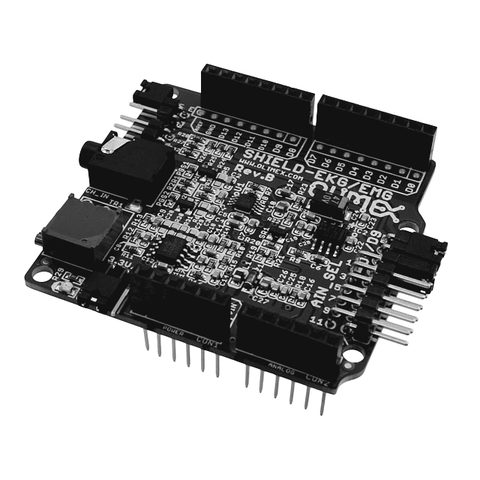 Olimex SHIELD-EKG-EMG
Analog front end. 0.16–40 Hz, ahead of the converter.
Olimex SHIELD-EKG-EMG
Analog front end. 0.16–40 Hz, ahead of the converter.
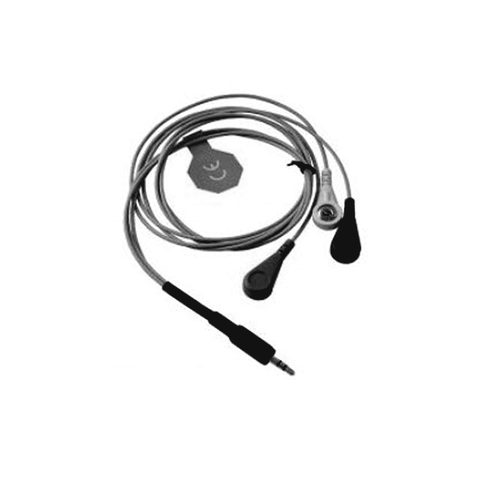 Olimex SHIELD-EKG-EMG-PRO
Passive electrode cable for the shield: 3.5 mm jack to three snap leads.
Olimex SHIELD-EKG-EMG-PRO
Passive electrode cable for the shield: 3.5 mm jack to three snap leads.
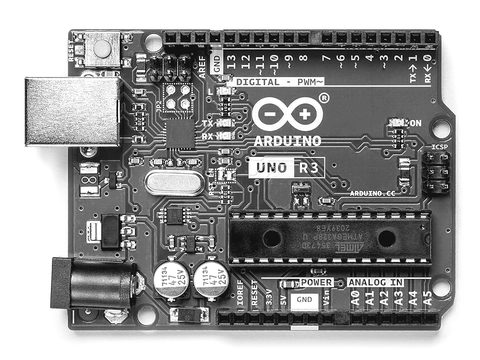 Arduino Uno R3
10-bit converter and USB serial.
Arduino Uno R3
10-bit converter and USB serial.
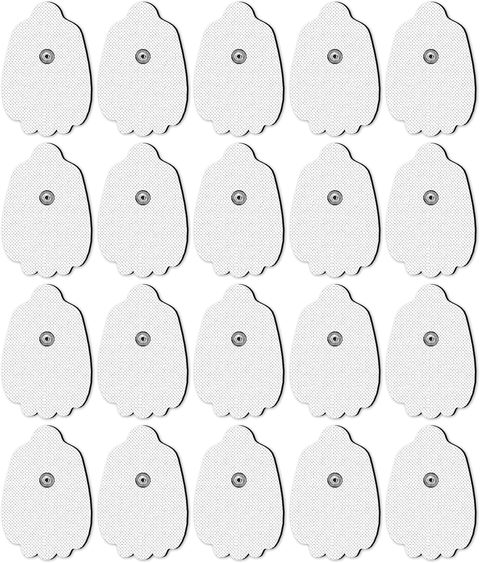 AVCOO snap TENS pads, 20
The electrodes. Self-adhesive, reusable gel.
AVCOO snap TENS pads, 20
The electrodes. Self-adhesive, reusable gel.
Board and microcontroller about C$75; the whole rig about C$106, at listing prices on 2026-09-13.
The firmware, the bridge and the recording workbench are public: olimex-shield.
| parameter | value |
|---|---|
| channels | 1 differential |
| montage | active Oz, reference Cz, ground mastoid; chosen for posterior alpha |
| electrodes | self-adhesive snap TENS pads — made for stimulation on skin, not recording through hair |
| impedance | not measured |
| analog band | 0.16–40 Hz, in the shield, ahead of the converter |
| converter | 10-bit |
| sample rate | 250 Hz in three captures, 256 Hz in three |
| gain | ≈2848, set by a hardware trimmer |
| scale | 7.9 µV/count from the built-in cal signal (nominal amplitude, not externally checked); datasheet implies 1.72 |
| input-referred noise | not measured |
| stimulus timing | not measured (below) |
| analysis | Python; Welch PSD; FOOOF for aperiodic separation |
Chosen on forum consensus that a costlier board buys a quieter front end, not a capability. No matched comparison was run. Landscape, checked 2026-08-25:
| channels | price | |
|---|---|---|
| Olimex SHIELD-EKG/EMG (this rig) | 1 | €19.95 |
| Olimex EEG-SMT | 2 | €99.00 |
| OpenBCI Cyton | 8 | $1,759 |
| OpenBCI Cyton + Daisy | 16 | $3,518 |
| OpenBCI Complete Ultracortex | 16 | $4,222 |
| OpenBCI Galea | — | $60,504 |
Timing: no number exists
Stimulus from Web Audio in a browser. EEG over USB serial. No loopback channel, no shared clock. No latency or jitter figure exists for this rig.
For scale: a consumer Bluetooth headband, tested with 5,000 pulses looped through its auxiliary input, measured a mean lag of 40 ms (±20 ms), with fewer than ten extreme latencies inflating the spread.
The serial stream carries a second column. It has not been confirmed as an independent input and may be a floating pin. Until it is, there is no known-good channel to loop the audio into.
Retention
| stage | kept |
|---|---|
| captures with ≥20 s usable pre-stimulus baseline | 6 of 12 |
| of those, protocol run to completion | 3 of 6 — two stopped in baseline, one in drive |
| resting-alpha resonance profiles scored usable by the app | 1 of 6 |
The five unusable profiles: drift-dominated baseline (1), no alpha peak above the 1/f floor (3), inconclusive at 12 Hz (1). The usable one peaks at 10 Hz with 2.8 dB SNR.
The headband validation above reports loss the same way: participants lost fell to one in twenty once its assistants had experience fitting the headband.

Alpha was the wrong calibration
The chain recovers resting alpha: SNR 36 in the good-contact capture, and one usable resonance profile of six. Alpha is the weakest available check: present at rest, needs no stimulus timing, exercises nothing between stimulus and record.
The planned replacement is a visual oddball. The headband validation used one — 25% oddballs, three blocks of 40 trials, filtered 0.1–15 Hz — and recovered the N200 and P300 on consumer hardware. Its task code and a data converter are published. A two-channel forehead-mounted system has been examined on the same two components.
An oddball tests stimulus, timing and record together, against a published yardstick. It needs a montage change first: the lab-grade arm of that validation measured the P300 at Pz. Oz–Cz is not a P300 montage.
The ask: analog bandwidth as a validation axis
Low-cost EEG validation has a channel axis: how few electrodes still recover ERPs. The two-channel work above sits on it. The validation read for this post targets the N200, P300 and reward positivity, and filtered its consumer arm at 0.1–15 Hz. For those components a 40 Hz analog ceiling costs nothing.
The other axis is analog bandwidth: how narrow the front end can be before a given evoked response is lost. None of the sources read for this post examine it. No systematic search was done, so it is not claimed to be untested. This rig sits on its edge: 40 Hz is the filter corner, and anything faster is gone before digitisation.
The proposal. A bandwidth sweep on existing lab-grade recordings. An oddball and a 40 Hz auditory steady-state response, each re-filtered with a causal low-pass at a series of cutoffs — for example 15, 30, 40, 60 and 100 Hz — reporting at each cutoff: component amplitude and latency, detection rate, and participants retained. A causal filter approximates an analog front end’s phase lag; a zero-phase filter would not. No new participants. The analysis would be done here, on the lab’s data, under the lab’s protocol.
Deliverable: a cutoff-versus-recovery table for components spanning the band.
The auditory question this started from
The alpha runs were isochronic tones at the alpha resonant frequency, looking for an aftereffect. The question underneath is auditory.
The medial superior olive is the first place in the ascending pathway where the two ears are compared. Phase-locked activity there produces a far-field potential, the neurophonic.
Engagement was with the released model, not the paper’s full text. The published code has no sodium conductance and no axon — an h-current and a low-threshold potassium current only — and reproduces the far-field without spike-generating machinery. A matched far-field licenses drive arrived at the nucleus. It does not license cells crossed threshold.
The defensible question: can a designed acoustic protocol put a specified structure into a recorded evoked response that tracks a parameter sweep and is distinguishable from a matched-energy tone? A delivery-verification methods result.
This rig cannot run it. The target sits at carrier rates in the hundreds of hertz; the analog filter removes it before the converter. A 100 Hz fundamental has zero harmonics in the passband, and no averaging recovers what was never digitised. Three consecutive workstreams were designed against that ceiling before it was checked.
Under dichotic drive the response envelope can modulate at the difference frequency with no acoustic envelope at either ear. That appears as sidebands around the carrier, not energy at the difference frequency. Whether a single channel can recover that structure is a hardware question.
The nearest published shape is 40 Hz sensory drive in mice, later combined auditory and visual.
Neither read at full text. Mouse tissue readout, not scalp EEG. Precedent that the shape exists, nothing more.
A sustained-response decay test is queued. If it fails, most of what was built on top of it was wasted. A null will be published.
Devil’s advocate
A distraction from the bench. The decay test needs a headphone, an electrode and an afternoon. Writing this is a legible way not to run it.
The instrument figures above are weaker than their first version. The median, the ratio and the attribution all changed on inspection. Anything else from this rig deserves the same recomputation before it is trusted.
A warm response does not solve the actual problem. A better instrument or montage does not give tissue access or pharmacological control.
Correction — 2026-09-13
This post originally stated a median in-band noise at 40 Hz of 238 nV across eight sessions, a broadband overstatement of 20–90×, that the spread showed electrode preparation dominates, and that the delivered stimulus envelope was measured rather than assumed. None held.
The 238 nV came from an analysis script that took the upper-middle of six values; the median is 157 nV, over six captures. “20–90×” was a hard-coded literal in the same script’s output; computed per capture it is 3.5–24×. The session records contradict the electrode-prep attribution. No stimulus-timing measurement exists. All four are corrected at source in the research records.
A paragraph noting that beta-band and dichotic runs had no producible records was removed rather than kept as anecdote. The post was restructured to lead with the instrument characterisation.
Update — 2026-09-25
The rig’s code is now public and linked from the parts list. The scale is described more exactly: 7.9 µV/count comes from the shield’s built-in calibration signal at its nominal amplitude, not from an externally injected signal.
Claims this post rests on
- AEP-0005 [C] A designed acoustic protocol can draw a specified compiled signal in the medial superior olive, recoverable from the recorded neurophonic and distinguishable from matched-energy plain tonotopic drive, at a drive level that published calibration places in the regime where activity-dependent calcium influx and transcription-factor activation are known to follow. AMENDED 2026-08-15b/c — the original wording claimed the drive could be placed ABOVE THE THRESHOLD FOR SUPRATHRESHOLD COINCIDENT FIRING. F-suprathreshold FIRED against that wording (the far-field is postsynaptic and cannot report firing) and was then RESTATED: firing is not the gating variable, calcium is, and subthreshold depolarization is a second documented route to it. See both dated sections.
Each claim is maintained in polarizetech/research with recorded
disproof conditions and disconfirming evidence. A tier is computed, never asserted.
Version history 9 revisions
Generated from this site's git history. with Claude means the commit carries a co-author line for an Anthropic model: an LLM took part in that change, not necessarily in every word of it, and git cannot say which. The same history on GitHub →
-
v9 2026-09-25 13:41 $70 board post: link the public olimex-shield repo, state the scale's provenance
- **Not explained by electrode prep.** The one capture the app scored good-contact (alpha SNR 36) has the highest value, 750 nV. The one it flagged no-scalp-contact gives 238 nV. The spread is unexplained.- **Not absolutely calibrated.** Counts convert at 7.9 µV/count,measuredderived from the shield's built-in calibration signal at its nominal amplitude; no external signal has been injected to check it. The datasheet implies 1.72. That 4.6× disagreement is unresolved, and every nV figure here inherits it.## Broadband RMS overstates in-band noise 3.5–24×Board and microcontroller about C$75; the whole rig about C$106, at listing prices on 2026-09-13.The firmware, the bridge and the recording workbench are public: [olimex-shield](https://github.com/polarizetech/olimex-shield).| parameter | value || gain | ≈2848, set by a hardware trimmer || scale | 7.9 µV/countmeasuredfrom the built-in cal signal (nominal amplitude, not externally checked); datasheet implies 1.72 || input-referred noise | **not measured** |A paragraph noting that beta-band and dichotic runs had no producible records was removed rather than kept as anecdote. The post was restructured to lead with the instrument characterisation.## Update — 2026-09-25The rig's code is now public and linked from the parts list. The scale is described more exactly:7.9 µV/count comes from the shield's built-in calibration signal at its nominal amplitude, not from an externally injected signal. -
v8 2026-09-25 08:23 Use polarize-ui for the design system and the blog components
## The rig<div class="ui-parts"> {% include part.html name="Olimex SHIELD-EKG-EMG" role="Analog front end. 0.16–40 Hz, ahead of the converter." price="C$34.02" href="https://www.digikey.ca/en/products/detail/olimex-ltd/SHIELD-EKG-EMG/3471383" img="/assets/posts/rig/olimex-shield-ekg-emg.jpg" credit="DigiKey" %} {% include part.html name="Olimex SHIELD-EKG-EMG-PRO" role="Passive electrode cable for the shield: 3.5 mm jack to three snap leads." price="C$16.91" href="https://www.digikey.ca/en/products/detail/olimex-ltd/SHIELD-EKG-EMG-PRO/5247133" img="/assets/posts/rig/olimex-shield-ekg-emg-pro-cable.jpg" credit="DigiKey" %} {% include part.html name="Arduino Uno R3" role="10-bit converter and USB serial." price="C$40.99" href="https://www.amazon.ca/dp/B008GRTSV6" img="/assets/posts/rig/arduino-uno-r3.jpg" credit="Amazon.ca" %} {% include part.html name="AVCOO snap TENS pads, 20" role="The electrodes. Self-adhesive, reusable gel." price="C$13.99" href="https://www.amazon.ca/dp/B09R1WSVJS" img="/assets/posts/rig/avcoo-snap-tens-pads.jpg" credit="Amazon.ca" %} </div>Board and microcontroller about C$75; the whole rig about C$106, at listing prices on 2026-09-13. -
v7 2026-09-13 17:08 Post: the $70 board, rebuilt around what the rig actually measures
description: >-An n-of-1 EEG rig, an analog ceiling that removes the signal I was designingfor, and a question I can't answer alone.A single-channel EEG rig characterised in numbers: in-band 40 Hz power acrosssix captures, why broadband RMS is the wrong figure to specify a rig by, and aproposed test of analog bandwidth as a validation axis.date: 2026-08-25 09:00:00 -0600citations:- krigolson2017- boere2023- goldwyn2014- iaccarino2016- martorell2019- goldwyn2014image: /assets/posts/eeg-recording-cap.jpg---Solo research programme, about two months old. The honest next step is to have someone tell me the instrument is inadequate.Written for people who validate portable EEG hardware. The ask is at the bottom and it is small.n-of-1 instrument characterisation. Written for people who validate low-cost EEG. One ask, after the rig sections. The auditory question that prompted the work is last.## In-band power at 40 Hz: median 157 nV, 11.7× spreadSix captures. One rig, one montage, one person. Amplitude at 40 Hz over 60 s of pre-stimulus baseline, estimated from neighbouring frequency bins.| | ||---|---|| median | **157 nV** || range | **64–750 nV** (11.7×) || captures with ≥20 s usable baseline | 6 of 12 || baseline segments whose noise integrates with dwell | 5 of 9; the other 4 are drift-limited |What this figure is not:- **Not instrument noise.** No shorted-input capture exists. This is in-band power of a scalp recording, EEG and scalp EMG included.- **Not explained by electrode prep.** The one capture the app scored good-contact (alpha SNR 36) has the highest value, 750 nV. The one it flagged no-scalp-contact gives 238 nV. The spread is unexplained.- **Not absolutely calibrated.** Counts convert at 7.9 µV/count, measured from the shield's calibration signal. The datasheet implies 1.72. That 4.6× disagreement is unresolved, and every nV figure here inherits it.## Broadband RMS overstates in-band noise 3.5–24×Specifying a rig by broadband RMS assumes white noise. EEG is drift-dominated. On the same six captures, a white-noise estimate built from broadband RMS put the 40 Hz noise **3.5–24× too high in amplitude** (median 15×), which is **12–594× too long in required dwell**.The error runs one direction: it declares runnable measurements unrunnable. A low-cost rig costed from a broadband figure gets ruled out of experiments it could run. Measure noise at the frequency of interest.Scope: six captures, one person, one rig. The direction transfers. The ratio may not.## The rigSingle-channel Olimex SHIELD-EKG/EMG on an Arduino. **Active Oz, reference Cz, ground mastoid** — a posterior montage chosen for alpha. 250 Hz sampling, 10-bit ADC at roughly7.9 µV per count, **~40 Hz analog low-pass**. Closed-back headphones. Python doing Welch PSD with FOOOF for aperiodic separation; Web Audio generating the stimulus, so the delivered envelope is measured rather than assumed.Microvolt EEG on a 10-bit converter is a few counts. Quantisation-limited and low-SNR by construction.## The alternatives, and why this board<div class="parts"> {% include part.html name="Olimex SHIELD-EKG-EMG" role="Analog front end. 0.16–40 Hz, ahead of the converter." price="C$34.02" href="https://www.digikey.ca/en/products/detail/olimex-ltd/SHIELD-EKG-EMG/3471383" img="/assets/posts/rig/olimex-shield-ekg-emg.jpg" credit="DigiKey" %} {% include part.html name="Olimex SHIELD-EKG-EMG-PRO" role="Passive electrode cable for the shield: 3.5 mm jack to three snap leads." price="C$16.91" href="https://www.digikey.ca/en/products/detail/olimex-ltd/SHIELD-EKG-EMG-PRO/5247133" img="/assets/posts/rig/olimex-shield-ekg-emg-pro-cable.jpg" credit="DigiKey" %} {% include part.html name="Arduino Uno R3" role="10-bit converter and USB serial." price="C$40.99" href="https://www.amazon.ca/dp/B008GRTSV6" img="/assets/posts/rig/arduino-uno-r3.jpg" credit="Amazon.ca" %} {% include part.html name="AVCOO snap TENS pads, 20" role="The electrodes. Self-adhesive, reusable gel." price="C$13.99" href="https://www.amazon.ca/dp/B09R1WSVJS" img="/assets/posts/rig/avcoo-snap-tens-pads.jpg" credit="Amazon.ca" %} </div>Board and microcontroller about C$75; the whole rig about C$106, at listing prices on 2026-09-13.| parameter | value ||---|---|| channels | 1 differential || montage | active Oz, reference Cz, ground mastoid; chosen for posterior alpha || electrodes | self-adhesive snap **TENS pads** — made for stimulation on skin, not recording through hair || impedance | **not measured** || analog band | 0.16–40 Hz, in the shield, ahead of the converter || converter | 10-bit || sample rate | 250 Hz in three captures, 256 Hz in three || gain | ≈2848, set by a hardware trimmer || scale | 7.9 µV/count measured; datasheet implies 1.72 || input-referred noise | **not measured** || stimulus timing | **not measured** (below) || analysis | Python; Welch PSD; FOOOF for aperiodic separation |BoughtChosen onhearsay —forum consensus thattheaexpensivecostlier board buys a quieter front endand convenience, not a capabilityyou cannot otherwise reach.**That is not a measurement.**No matched-conditions noise-floorcomparisonof the two has been seen here, and nonewas run. Landscape,becausecheckedrunning one means owning both.2026-08-25:Landscape, checked 2026-08-25:| | channels | price ||---|---|---|| Olimex SHIELD-EKG/EMG *(whatthisI haverig)* | 1 | **€19.95** || Olimex EEG-SMT | 2 | €99.00 || OpenBCI Galea | — | $60,504 |The gap between rows one and three is the question. Two failure modes that cannot be ruled out from here: the noise-floor claim may hold for alpha and fail for anything smaller; or the wrong axis was optimised entirely, in which case **neither** Olimex board solves the problem and cheap-versus-expensive was never the interesting comparison.##TheTiming:noisenofloornumber existsMedian in-band noise at 40 Hz over 60 s: **238 nV**, ranging 65 to 750 nV across eight sessions. An **11× spread on the same hardware in the same room** — electrode prep dominates everything the software does.One correction worth passing on. A broadband RMS figure had been carried as if it were the noise floor at the frequency of interest. Real EEG is drift-dominated, so broadband RMS**overstated 40 Hz noise by 20–90× in amplitude.** That error declares a runnable measurement unrunnable, which quietly kills experiments that should have been attempted.Stimulus from Web Audio in a browser. EEG over USB serial. No loopback channel, no shared clock.**No latency or jitter figure exists for this rig.**For scale: a consumer Bluetooth headband, tested with 5,000 pulses looped through its auxiliary input, measured a mean lag of 40 ms (±20 ms), with fewer than ten extreme latencies inflating the spread.{% include source.html key="krigolson2017" %}The serial stream carries a second column. It has not been confirmed as an independent input and may be a floating pin. Until it is, there is no known-good channel to loop the audio into.## Retention| stage | kept ||---|---|| captures with ≥20 s usable pre-stimulus baseline | 6 of 12 || of those, protocol run to completion | 3 of 6 — two stopped in baseline, one in drive || resting-alpha resonance profiles scored usable by the app | 1 of 6 |The five unusable profiles: drift-dominated baseline (1), no alpha peak above the 1/f floor (3), inconclusive at 12 Hz (1). The usable one peaks at 10 Hz with 2.8 dB SNR.The headband validation above reports loss the same way: participants lost fell to one in twenty once its assistants had experience fitting the headband.##WhatAlphahaswasbeentherunwrong calibrationThe chain recovers resting alpha: SNR 36 in the good-contact capture, and one usable resonance profile of six. Alpha is the weakest available check: present at rest, needs no stimulus timing, exercises nothing between stimulus and record.The planned replacement is a visual oddball. The headband validation used one — 25% oddballs, three blocks of 40 trials, filtered 0.1–15 Hz — and recovered the N200 and P300 on consumer hardware. Its task code and a data converter are published. A two-channel forehead-mounted system has been examined on the same two components.{% include source.html key="boere2023" %}An oddball tests stimulus, timing and record together, against a published yardstick. It needs a montage change first: the lab-grade arm of that validation measured the P300 at Pz. Oz–Cz is not a P300 montage.## The ask: analog bandwidth as a validation axisLow-cost EEG validation has a channel axis: how few electrodes still recover ERPs. The two-channel work above sits on it. The validation read for this post targets the N200, P300 and reward positivity, and filtered its consumer arm at 0.1–15 Hz. For those components a 40 Hz analog ceiling costs nothing.The other axis is analog bandwidth: how narrow the front end can be before a given evoked response is lost. None of the sources read for this post examine it. No systematic search was done, so it is not claimed to be untested. This rig sits on its edge: 40 Hz is the filter corner, and anything faster is gone before digitisation.**The proposal.** A bandwidth sweep on existing lab-grade recordings. An oddball and a 40 Hz auditory steady-state response, each re-filtered with a causal low-pass at a series of cutoffs — for example 15, 30, 40, 60 and 100 Hz — reporting at each cutoff: component amplitude and latency, detection rate, and participants retained. A causal filter approximates an analog front end's phase lag; a zero-phase filter would not. No new participants. The analysis would be done here, on the lab's data, under the lab's protocol.**Deliverable:** a cutoff-versus-recovery table for components spanning the band.## The auditory question this started fromIsochronicThe alpha runs were isochronic tones at the alpha resonant frequency, looking fora measurablean aftereffect. The question underneath is auditory.Reported as the data reads, not as remembered. **Of six resonance profiles on file, five are `inconclusive`** — flagged by the app as drift-dominated, or with no alpha peak above the 1/f floor, or with a peak below the alpha band entirely. The one marked `strong` sits at 10 Hz with 2.8 dB SNR. The best recorded run gives a resonant frequency of 11 Hz against a peak of 9.77, a divergence of 1.23 Hz, and its own verdict is **`LOW QUALITY / no valid comparison`**.So: the chain demonstrably recovers alpha, and that counts as **rig validation and nothing else** — evidence that board, electrode, amplifier and analysis code together find a real, expected signal. A calibration, not a finding. n = 1, unblinded, no sham for arousal or attention, effect measured *during* drive rather than after, and acute entrainment of an ongoing oscillation is among the least surprising results in the auditory literature.A beta-band version and dichotic drive experiments were also run. **No numbers are reported for either, because the records cannot currently be produced.** The beta app was retired and its results are not where expected. Until the data can be put in front of you, those are anecdotes.## The published precedentThe medial superior olive is the first place in the ascending pathway where the two ears are compared. Phase-locked activity there produces a far-field potential, the neurophonic.{% include source.html key="goldwyn2014" %}Engagement was with the released model, not the paper's full text. The published code has **no sodium conductance and no axon** — an h-current and a low-threshold potassium current only — and reproduces the far-field without spike-generating machinery. A matched far-field licenses *drive arrived at the nucleus*. It does not license *cells crossed threshold*.The defensible question: can a designed acoustic protocol put a specified structure into a recorded evoked response that tracks a parameter sweep and is distinguishable from a matched-energy tone? A delivery-verification methods result.This rig cannot run it. The target sits at carrier rates in the hundreds of hertz; the analog filter removes it before the converter. A 100 Hz fundamental has **zero harmonics in the passband**, and no averaging recovers what was never digitised. Three consecutive workstreams were designed against that ceiling before it was checked.Under dichotic drive the response envelope can modulate at the difference frequency with no acoustic envelope at either ear. That appears as **sidebands around the carrier**, not energy at the difference frequency. Whether a single channel can recover that structure is a hardware question.The nearestthing in the literature to thepublished shapebeing chasedisthe40 Hz sensory driveworkinmouse modelsmice, laterextended tocombined auditory and visualstimulation.{% include source.html key="iaccarino2016" %} {% include source.html key="martorell2019" %}Cited as **precedent that the shape exists**, not as support. Neither was read at full text. Four differences bound how far they travel: mouse versus human, invasive tissue readout versus scalp EEG, 40 Hz gamma versus alpha, cortex and hippocampus versus a brainstem nucleus. **The readout difference is binding.** Those studies read the consequence in tissue. Nothing available here reads anything but a far-field.## The gapThe interesting version of the question lives in the medial superior olive — the first place in the ascending pathway where the two ears are compared. There is a far-field potential from phase-locked activity there, the neurophonic.The constraint comes from modelling work on that signal.{% include source.html key="goldwyn2014" %}Engagement here was with the released model rather than the paper's full text, so only what is checkable is stated: the published code contains **no sodium conductance and no axon** — only an h-current and a low-threshold potassium current — and it reproduces the far-field with no spike-generating machinery in it.Taken seriously rather than routed around. A matched far-field licenses *drive arrived at the nucleus*. It does not license *cells crossed threshold*. Those are different statements and a postsynaptic far-field cannot separate them. Most of the downstream biology of interest depends on the second.So the defensible claim is smaller: **can a designed acoustic protocol put a specified structure into a recorded evoked response, such that it tracks a parameter sweep and is distinguishable from a matched-energy plain tone?** A delivery-verification question. A methods result. Runnable.Except for one thing.## The analog ceilingThe board passes roughly 0.16 to 40 Hz. The signal needed sits at carrier rates in the hundreds of hertz.Not a limitation to work around. Reviewing the logs, **three consecutive workstreams were designed against an instrument whose bandwidth removes the target signal.** The question was fitted to the rig rather than the rig chosen for the question. A reasoning failure, not a hardware problem.Fatal rather than inconvenient because the filter is in silicon *ahead of the converter*. A 100 Hz fundamental has **zero harmonics inside the passband.** No dwell, no averaging, no clever choice of stimulus frequency recovers what was removed before digitisation. Hence the viability gate — *is the readout in the analog band at all* — before building anything.A partial escape: under dichotic drive the response envelope can modulate at the difference frequency even though no envelope exists acoustically at either ear. That appears spectrally as **sidebands around the carrier**, not as energy at the difference frequency — searching at the difference frequency is a null about a frequency the physics never predicted. Whether a single-channel Oz–Cz montage can recover sideband structure at all is open, and it is a hardware question.## What I'd likeNot a collaborator, co-author or funding. A competence I do not have.1. **A bandwidth reality check.** Is a sub-$100 board recoverable into a usable range with better front-end filtering and averaging, or is the ceiling the ceiling?2. **A montage correction.** Oz–Cz was chosen for alpha, then inherited by a question it does not suit. What would you use?3. **A benchmark, if there is appetite.** How far does consumer-grade EEG extend before it stops recovering what lab-grade systems get, and where is the boundary? Publishable with or without this programme attached, and I would run the tedious conditions.Neither read at full text. Mouse tissue readout, not scalp EEG. Precedent that the shape exists, nothing more.Abench test is queued that will probably close a large part of this programme — asustained-response decaymeasurementtest is queued. If it fails, most of what was builtdownstreamon top of it was wastedeffort. **A nullis a result and itwill be published.**## Devil's advocate**A distraction from the bench.** Thesustained-responsedecay test needs a headphone, an electrode and an afternoon.It has been the named next step for weeks.Writingan outreach postthis is a legible way not tonotrun it, and that risk is live.**The interesting claim and the defensible claim have come apart.** What is defensible is a delivery-verification methods result. What prompted the work was more ambitious. A hostile reader can grant the first and deny it bears on the second, and nothing here answers them.**The instrument figures above are weaker than their first version.** The median, the ratio and the attribution all changed on inspection. Anything else from this rig deserves the same recomputation before it is trusted.**A warm response does not solve the actual problem.**BetterA better instrument,correctedor montage—doesneithernotgetsgive tissue accessandor pharmacological control.That is a different building, probably a different institution, possibly a different species.## Correction — 2026-09-13This post originally stated a median in-band noise at 40 Hz of **238 nV across eight sessions**, a broadband overstatement of **20–90×**, that the spread showed **electrode preparation dominates**, and that the delivered stimulus envelope was **measured rather than assumed**. None held.The 238 nV came from an analysis script that took the upper-middle of six values; the median is 157 nV, over six captures. "20–90×" was a hard-coded literal in the same script's output; computed per capture it is 3.5–24×. The session records contradict the electrode-prep attribution. No stimulus-timing measurement exists. All four are corrected at source in the research records.A paragraph noting that beta-band and dichotic runs had no producible records was removed rather than kept as anecdote. The post was restructured to lead with the instrument characterisation. -
v6 2026-09-12 07:54 posts: inline source cards, and every post cut to the point
status: publishedinline_sources: truetier: C---I've been running a soloSolo researchprogram forprogramme, about two months old. The honest next step is to have someone tell memythe instrument is inadequate.This is the rig, what it has shown, and the gap. It's writtenWritten for people who validate portable EEG hardwarefor a living. The ask is at the bottom and it'sis small.## The rigA singleSingle-channel Olimex SHIELD-EKG/EMG on an Arduino. **Active Oz, reference Cz, ground mastoid** — a posterior montage chosen for alpha. 250 Hz sampling, 10-bit ADC at roughly7.9 µV per count,and a**~40 Hz analog low-pass**. Closed-back headphones. Python doing Welch PSD with FOOOF for aperiodic separation, and; Web Audio generating the stimulus, so the delivered envelope is measured rather than assumed.Microvolt EEG on a 10-bit converter isonlya few counts.It's quantisationQuantisation-limited and low-SNR by construction, and I want to be precise about what it has and hasn't shown.## Why this board, and what the alternatives cost## The alternatives, and why this boardI bought the cheap boardBought on hearsay — forum consensus that the expensiveoneboard buys a quieter front end and convenience, not a capability youcan'tcannot otherwise reach. **That'sis not a measurement.**I've never seen aNo matched-conditions noise-floor comparison of the two has been seen here, andInonedidn'twas runone, because running one means owning both.Here's the actual landscapeLandscape, checked 2026-08-25:| | channels | price || OpenBCI Galea | — | $60,504 |The gap between rows one and three is thewholequestion. Two failure modesIthatcan'tcannotrulebe ruled out from here: the noise-floor claim may hold for alpha and fail for anything smaller; orI optimisedthe wrong axis was optimised entirely, in which case **neither** Olimex board solvesmythe problem and cheap-versus-expensive was never the interesting comparison.##What theThe noise flooractually isMedian in-band noise at 40 Hz over 60 s: **238 nV**, ranging 65 to 750 nV across eight sessions. An **11× spread on the same hardware in the same room** — electrode prep dominates everything the software does.One correction worth passing on, because it pointed the dangerous way.I'd been carrying aA broadband RMS figure had been carried as if it were the noise floor at the frequency of interest. Real EEG is drift-dominated, so broadband RMS**overstated 40 Hz noise by 20–90× in amplitude**. That error declares a runnable measurement unrunnable, which quietly kills experiments you should have attempted.**overstated 40 Hz noise by 20–90× in amplitude.** That error declares a runnable measurement unrunnable, which quietly kills experiments that should have been attempted.## WhatI'vehasactuallybeen runIsochronic tones at the alpha resonant frequency, looking for a measurable aftereffect.IReportedwant to report this the wayas the data reads,rathernotthanasthe way I remember itremembered. **Of six resonance profiles on file, five are `inconclusive`** — flagged by the appitselfas drift-dominated, or with no alpha peak above the 1/f floor, or with a peak below the alpha band entirely. The onesessionmarked `strong` sits at 10 Hz with 2.8 dB SNR.MyThe best recorded run gives a resonant frequency of 11 Hz against a peak of 9.77, a divergence of 1.23 Hz, and its own verdict is **`LOW QUALITY / no valid comparison`**.So: the chain demonstrably recovers alpha, andIthattreat thatcounts as **rig validation and nothing else** — evidence that board, electrode, amplifier and analysis code together find a real, expected signal.It is aA calibration, not a finding. n = 1, unblinded, no sham for arousal or attention, effect measured *during* drive rather than after, and acute entrainment of an ongoing oscillation is among the least surprising results in the auditory literature.I also ran aA beta-band versionof thisandexperimented withdichotic drive—experimentsaweredifferentalsotone in each ear, 10 Hz apart, with an isochronic envelope on toprun. **I'm not reportingNo numbers are reported for either, becauseIthecan'trecords cannot currentlyproducebethe recordsproduced.** The beta app was retired and its resultsaren'tare not whereIexpectedthem. UntilIthe data can be putthe datain front of you, those are anecdotesand I'd rather say so.## The published precedentThe nearest thing in the literature to the shapeI'mbeingchasingchased is theMIT gamma work —40 Hz sensory driveproducing downstream cellular consequenceswork in mouse models{% include cite.html key="iaccarino2016" %}, later extended to combined auditory and visual stimulation{% include cite.html key="martorell2019" %}.{% include source.html key="iaccarino2016" %} {% include source.html key="martorell2019" %}I cite theseCited as **precedent that the shape exists**, not as support.INeitherhaven'twas readeitherat full text,.and fourFour differences bound how far they travel: mouse versus human, invasive tissue readout versus scalp EEG, 40 Hz gamma versus alpha, cortex and hippocampus versus a brainstem nucleus. **The readout difference isthebindingone.** Those studies read the consequence in tissue. NothingIavailablecan dohere reads anything but a far-field.## The gapThe interesting version ofmythe question lives in the medial superior olive — the first place in the ascending pathway where the two ears are compared. There'sis a far-field potential from phase-locked activity there, the neurophonic.The constraint comes from modelling work on that signal.{% include source.html key="goldwyn2014" %}TheEngagementconstraintherecomes from the modelling work on that signal {% include cite.html key="goldwyn2014" %}. I've engagedwas with the released model rather than the paper's full text, soI'll stateonly what'sis checkable is stated: theauthors'published code contains **no sodium conductance and no axon** — only an h-current and a low-threshold potassium current — and it reproduces the far-field with no spike-generating machinery in itat all.I've taken that seriously rather than routing around it. A matched far-field licensesTaken seriously rather than routed around. A matched far-field licenses *drive arrived at the nucleus*. It does not license *cells crossed threshold*. Those are different statements and a postsynaptic far-fieldcan'tcannot separate them. Most of the downstream biologyIofcare aboutinterest depends on the second, and I can't get there with this instrument — or, as far as I can tell, with any non-invasive one.So the defensible claim is smaller: **can a designed acoustic protocol put a specified structure into a recorded evoked response, such that it tracks a parameter sweep and is distinguishable from a matched-energy plain tone?** A delivery-verification question. A methods result. Runnable.## The analog ceilingThe board passes roughly 0.16 to 40 Hz. The signalI needneeded sits at carrier rates in the hundreds of hertz.ThisNotis not "a limitation to work around."Reviewingmy ownthe logsI found that, **three consecutive workstreams were designed against an instrument whose bandwidth removes the target signal.** The question was fitted to the rig rather than the rig chosen for the question.That's aA reasoning failure, not a hardware problem, and I'd rather name it than have someone else find it.It's fatalFatal rather than inconvenient because the filter is in silicon *ahead of the converter*. A 100 Hz fundamental has **zero harmonics inside the passband.**.No dwell, no averaging, no clever choice of stimulus frequency recovers what was removed before digitisation.IHencenow run athe viability gate — *is the readout in the analog band at all* — before building anything, because I built an entire apparatus first and computed that gate afterwards.There's aA partial escape.:Underunder dichotic drive the response envelope can modulate at the difference frequency even though no envelope exists acoustically at either ear. That appears spectrally as **sidebands around the carrier**, not as energy at the difference frequency — searching at the difference frequency is a null about a frequency the physics never predicted. Whether a single-channel Oz–Cz montage can recover sideband structure at all is open, and it'sis a hardware question.## What I'd likeNot a collaborator, co-author,or funding. A competence Idon'tdo not have.1. **A bandwidth reality check.** Is a sub-$100 board recoverable into a usable range with better front-end filtering and averaging, or is the ceiling the ceiling?2. **A montage correction.** Oz–Cz was chosen for alpha, then inherited by a question itdoesn'tdoes not suit. What would you use?3. **A benchmark, if there'sis appetite.** How far does consumer-grade EEG extend before it stops recovering what lab-grade systems get, and whereexactlyis the boundary?That's publishablePublishable with or withoutmythisprogramprogramme attached, and I'dwould run the tedious conditions.I have aA bench test is queued that will probably close a large part ofmythisprogramprogramme — a sustained-response decay measurement. If it fails, most of whatI'vewas built downstream was wasted effort. **A null is a result andIit willpublishbeitpublished.**If you have five minutes and an opinion about my montage, I'd like to hear it.## Devil's advocate**It's aA distraction from the bench.** The sustained-response test needs a headphone, an electrode,and an afternoon. It'shas been the named next step for weeks. Writing an outreach post is a legible way to not run it, and that risk is live.**The interesting claim and the defensible claim have come apart.** WhatIiscan defenddefensible is a delivery-verification methods result. Whatmadepromptedmethestartwork was more ambitious. A hostile reader can grant the first and deny it bears on the second, and nothing here answers them.That's the correct state to be in and I'd rather sit in it visibly.**Even aA warm responsedoesn'tdoes not solvemythe actual problem.** Better instrument, corrected montage — neither getsmetissue access and pharmacological control. That'sis a different building, probably a different institution,andpossibly a different species. -
v5 2026-09-03 15:17 site: images on every post, bigger thumbnails, CTA moves into the sidebar
- goldwyn2014image: /assets/posts/eeg-recording-cap.jpgimage_alt: >-A person wearing a multi-electrode EEG recording cap in profile, ringedelectrodes and their lead wires covering the scalp.image_credit: Chris Hopeimage_license: CC BY 2.0image_license_url: https://creativecommons.org/licenses/by/2.0/image_source_url: https://commons.wikimedia.org/wiki/File:EEG_Recording_Cap.jpg--- -
v4 2026-09-02 20:46 posts: publish the cheap-EEG validation-gap post
project: audio-evoked-potentialsstatus:draftpublishedtier: C -
v3 2026-08-31 15:57 site: adopt the monorepo design system, add two posts, publish the AI disclosure
## The rigA single-channel Olimex SHIELD-EKG-/EMG on an Arduino. **Active Oz, reference Cz, ground mastoid** — a posterior montage chosen for alpha. 250 Hz sampling, 10-bit ADC at roughly7.9 µV per count, and a **~40 Hz analog low-pass**. Closed-back headphones. Python doing Welch PSD with FOOOF for aperiodic separation, and Web Audio generating the stimulus, so the delivered envelope is measured rather than assumed.|---|---|---|| Olimex SHIELD-EKG-/EMG *(what I have)* | 1 | **€19.95** || Olimex EEG-SMT | 2 | €99.00 | -
v2 2026-08-26 07:27 post: GENUS precedent, live pricing, montage, and a tightening pass
description: >-Notes on anAn n-of-1 EEG rig, an analog ceiling that removes the signal I was designingdesigningfor, and a question I can't answer alone.date: 2026-08-25 09:00:00 -0600citations:- iaccarino2016- martorell2019- goldwyn2014---I've been running a solo research program for about two months,.and I've reached the point where theThe honest next step is to have someone tell me my instrument is inadequate.Thispostisa description ofthe rig,onewhatresultit has shown, andonethe gap. It's written for people who validate portable EEG hardware for a living— a category that includes at least one lab a fifteen-minute drive from where I'm sitting.If that's you, theThe ask is at the bottom and it's small.## ThesetuprigA single-channel Olimex SHIELD-EKG-EMG on an Arduino, Oz–Cz montage, closed-back headphones, and a Python stack doing Welch PSD with FOOOF for aperiodic separation. Stimulus generation is Web Audio in the browser, which means the delivered envelope is measured rather than assumed — a distinction that turns out to matter, because hard gating of an amplitude-modulated tone injects a second harmonic that a raised-cosine ramp doesn't.A single-channel Olimex SHIELD-EKG-EMG on an Arduino. **Active Oz, reference Cz, ground mastoid** — a posterior montage chosen for alpha. 250 Hz sampling, 10-bit ADC at roughly7.9 µV per count, and a **~40 Hz analog low-pass**. Closed-back headphones. Python doing Welch PSD with FOOOF for aperiodic separation, and Web Audio generating the stimulus, so the delivered envelope is measured rather than assumed.That'sMicrovolttheEEGwholeonapparatusa 10-bit converter is only a few counts. It'saquantisation-limitedhobbyistandriglow-SNR byany reasonable standardconstruction, and I want to be precise about what it has and hasn't shown.## WhythethisEKG/EMG shieldboard, andnotwhat theEEG-SMTalternatives costThis is the first decision I'd like checked, because I made it on hearsay.Olimex sells a purpose-built EEG board — the EEG-SMT — and I didn't buy it. It's roughly five times the price, and the argument I found in hobbyist EEG communities was that the SMT's advantage is essentially a quieter front end, which you can approach on the cheaper shield with careful grounding, shielded leads, good electrode prep, and a short cable run. The reasoning was that the expensive board buys convenience and a better noise floor out of the box, not a capability you can't otherwise reach.The epistemic status of that matters. **It's forum consensus, not a measurement.** I haven't seen a side-by-side noise-floor comparison of the two boards under matched conditions, and I didn't run one, because running one requires owning both — which defeats the purpose of the decision. So I bought the cheap board on an unverified claim and then built two months of work on top of it.That may well have been fine. But there are two failure modes I can't rule out from where I'm standing:- **The noise-floor claim may hold for alpha and fail for anything smaller.** A board adequate for a 10 Hz cortical rhythm at microvolt scale says nothing about a far-field brainstem potential two or three orders of magnitude down.- **I may have optimised the wrong axis entirely.** If analog bandwidth is the binding constraint — see below — then neither Olimex board solves my problem and the cheap-versus-expensive question was never the interesting one. Cheap and wrong is not better than expensive and wrong.If someone with a calibrated signal generator has ever put these two boards on a bench together, I'd like to see the numbers.I bought the cheap board on hearsay — forum consensus that the expensive one buys a quieter front end and convenience, not a capability you can't otherwise reach. **That's not a measurement.** I've never seen a matched-conditions noise-floor comparison of the two, and I didn't run one, because running one means owning both.Here's the actual landscape, checked 2026-08-25:| | channels | price ||---|---|---|| Olimex SHIELD-EKG-EMG *(what I have)* | 1 | **€19.95** || Olimex EEG-SMT | 2 | €99.00 || OpenBCI Cyton | 8 | $1,759 || OpenBCI Cyton + Daisy | 16 | $3,518 || OpenBCI Complete Ultracortex | 16 | $4,222 || OpenBCI Galea | — | $60,504 |The gap between rows one and three is the whole question. Two failure modes I can't rule out from here: the noise-floor claim may hold for alpha and fail for anything smaller; or I optimised the wrong axis entirely, in which case **neither** Olimex board solves my problem and cheap-versus-expensive was never the interesting comparison.## What therig'snoise floor actually isSince writing the above I've measured the part I can measure, across eight sessions on this rig.The headline is that **electrode prep dominates everything the software does.**Median in-band noise at 40 Hz overa6060-second window iss: **238 nV**,with a session-to-session range ofranging 65 to 750 nV—acrossaneight sessions. An **11× spread on the same hardware in the same room.**No—processingelectrodechoiceprepIdominateshave made moveseverything theresult as much as that spreadsoftware does.One correctionisworth passing on, because it pointed the dangerous way. Ihad'd been carrying a broadband RMS figure asthoughif it were the noise floor at the frequency of interest. Real EEG is drift-dominated, soabroadband RMS **overstatedthe noise at40 Hz noise by 20–90× in amplitude**— thousands of times over in required dwell. That error declares a runnable measurement unrunnable, whichis the direction thatquietly kills experiments you should have attempted.##TheWhatoneI'veresultactually runIsochronic auditory drive at individual alpha frequency (~9.7 Hz for me) produces roughly a **22% rise in alpha-band power at IAF** during stimulation, reproducibly, on-rig.Every caveat you're already forming is correct. **n = 1.** No blinding. No sham designed to control for arousal or attention. Single channel, non-standard montage, and Oz–Cz is not what anyone would choose for this if they had a choice. The effect is acute — measured *during* drive, not after — and acute entrainment of an ongoing oscillation is one of the least surprising things in the auditory literature.Isochronic tones at the alpha resonant frequency, looking for a measurable aftereffect.I want to report this the way the data reads rather than the way I remember it. **Of six resonance profiles on file, five are `inconclusive`** — flagged by the app itself as drift-dominated, or with no alpha peak above the 1/f floor, or with a peak below the alpha band entirely. The one session marked `strong` sits at 10 Hz with 2.8 dB SNR. My best recorded run gives a resonant frequency of 11 Hz against a peak of 9.77, a divergence of 1.23 Hz, and its own verdict is **`LOW QUALITY / no valid comparison`**.So: the chain demonstrably recovers alpha, and I treatthisthat as **rig validation and nothing else**:— evidence thattheboard,theelectrode,theamplifierchainandmyanalysis code togethercan recoverfind a real, expected signal. It'sis a calibration, not a finding. n = 1, unblinded, no sham for arousal or attention, effect measured *during* drive rather than after, andit'sacutefiledentrainmentatof an ongoing oscillation is among thelowestleasttiersurprisingthisresultsprojectinhasthe—auditorya first-person unblinded observation, which no amount of repetition can promoteliterature.One further honesty note. When I went to record that result formally, I found it had only ever existed as a number quoted inside a design document — the sessions were never logged at the granularity that would let me recover exact dates or per-session figures. So read the 22% as approximate, and read its registration as retroactive, which is weaker than pre-registered.I also ran a beta-band version of this and experimented with dichotic drive — a different tone in each ear, 10 Hz apart, with an isochronic envelope on top. **I'm not reporting numbers for either, because I can't currently produce the records.** The beta app was retired and its results aren't where I expected them. Until I can put the data in front of you, those are anecdotes and I'd rather say so.## Thegap,publishedstated plainlyprecedentThe nearest thing in the literature to the shape I'm chasing is the MIT gamma work — 40 Hz sensory drive producing downstream cellular consequences in mouse models {% include cite.html key="iaccarino2016" %}, later extended to combined auditory and visual stimulation {% include cite.html key="martorell2019" %}.I cite these as **precedent that the shape exists**, not as support. I haven't read either at full text, and four differences bound how far they travel: mouse versus human, invasive tissue readout versus scalp EEG, 40 Hz gamma versus alpha, cortex and hippocampus versus a brainstem nucleus. **The readout difference is the binding one.** Those studies read the consequence in tissue. Nothing I can do reads anything but a far-field.## The gapThe interesting version of my question livesin the auditory brainstem,in the medial superior olive — the first place in the ascending pathway wheresignals fromthe two ears are compared. There's a far-field potentialassociated withfrom phase-locked activity there,calledthe neurophonic.The constraintI've had to absorbcomes from the modelling work on thatpotentialsignal {% include cite.html key="goldwyn2014" %}. Iwant to be careful about how I state this, because I have've engaged with the released model rather thanwiththe paper's full text.,Whatso I'llcan verify directly isstate what'sincheckable: the authors'ownpublished code:contains **the model containsno sodium conductance and no axonat all** — onlyaanhyperpolarisationh-activatedcurrent and a low-threshold potassium current.It— and it reproduces the far-fieldsignalwithwithout anyno spike-generating machinery in it at all.I've takenthe implicationthat seriously rather than routing around it. A matched far-field licensesthe claim *phase-locked drive arrived at the nucleus*. It does not license*drive arrived at the nucleus*. It does not license *cells crossed threshold*. Those are different statements,and a postsynaptic far-fieldcannotcan'tdistinguishseparate them.MuchMost of theinterestingdownstream biology I care about depends on the secondone, and I can't get there withthethis instrumentI have— or, as far as I candeterminetell, with any non-invasiveinstrumentone.So the defensible claimI'm left withis smallerand more defensible: **can a designed acoustic protocol put a specified structure into a recorded evoked response, such thatthe structureit tracks adesignedparameter sweep and is distinguishable from a matched-energy plain tone?**That's aA delivery-verification question.It's aA methods result.It's also runnableRunnable.Except for one thing.## The analog ceilingTheOlimexboard passes roughly 0.16 to 40 Hz. The signal I needto characterisesits at carrier rates in the hundreds of hertz.I want to be blunt about what that means, because I've caught myself doing the softer version. It is not "a limitation to work around." Reviewing my own logs, I found thatThis is not "a limitation to work around." Reviewing my own logs I found that **three consecutive workstreams were designed against an instrument whose bandwidth removes the target signal.** The question wasbeingfitted to the rig rather than the rig chosen for the question. That's a reasoning failure, not a hardware problem, it's a reasoning failure, and I'd rather name it than have someone else find it.The reason itIt's fatal rather than inconvenientis thatbecause the filter is in silicon *ahead of the converter*. A 100 Hzresponsefundamental has **zero harmonics inside the passband**. Noamount ofdwell, no averaging,orno clever choice of stimulus frequency recoverssomething thatwhat was removed beforethe signal was digitiseddigitisation. I now run a viability gate — *is the readout in the analog band at all* — before building anything, because I built an entire apparatus first and computed that gate afterwards.There's a partial escape. Under dichotic drive — a slightly different pure tone to each ear — the envelope of the response can modulate at the difference frequency even though no envelope exists acoustically at either ear. That structure appears spectrally asThere's a partial escape. Under dichotic drive the response envelope can modulate at the difference frequency even though no envelope exists acoustically at either ear. That appears spectrally as **sidebands around the carrier**, not as energy at the difference frequencyitself.—Searchingsearching at the difference frequency is a null about a frequency the physics never predicted. Whether a single-channel Oz–Cz montage can recover sideband structure at all isgenuinelyopen, and it's a hardware question, not a theory question.## What I'd likeI'm not looking forNot a collaborator,aco-author, or funding.I'm looking for aA competence I don't have.1. **A bandwidth reality check.** Is a sub-$100 board recoverable into a usable range with better front-end filtering and averaging, or is the ceiling the ceiling?I suspect I know, but I've been wrong about hardware before and I'd rather be told than discover it after another month.2. **A montage correction.** Oz–Cz was chosen for alpha, then inherited by a question it doesn't suit. What would you use?3. **A benchmark, if there's appetite.**There's a real methodological question here: howHow far does consumer-grade EEG extend before it stops recoveringsignalswhat lab-grade systems get, and where exactly is the boundary? That's publishable with or without my program attached, and I'dhappilyrun the tediouscomparisonconditions.I have a bench test queued that will probably close a large part of my program — a sustained-response decay measurement, testing whether the candidate envelope holds above 50% of initial amplitude. If it fails, most of what I've built downstream was wasted effort, and I'd rather find out this month than next year. **A null is a result and I will publish it.**If you have five minutes and an opinion about my montage, I'd like to hear it.## Devil's advocateThree objections I'd rather raise than have raised.**It's a distraction from the bench.** The sustained-response test needs a headphone, an electrode, and an afternoon. Ithas's been the named next step for weeks. Writing an outreach post is a legible, satisfyingway to not run it, and that risk is live.**The interesting claim and the defensible claim have come apart.** What I can defend is a delivery-verification methods result. What made me start wasconsiderablymore ambitious. A hostile reader can grant the firstentirelyand deny it bears on the second, and nothingabovehere answers them.I think thatThat's the correct state to be in,and I'd rather sit in it visibly.**Even a warm response doesn't solve my actual problem.**EEGBettermethodologyinstrument,expertisecorrected montage — neither gets mea better instrument and a corrected montage. It doesn't get me what the ambitious half of the question requires, which istissue access and pharmacological control.—That's a different building, probably a different institution, and possibly a different species. -
v1 2026-08-26 06:48 draft: can a $70 board tell me I'm wrong?
v1: the original version, as first committed. Read it on GitHub →